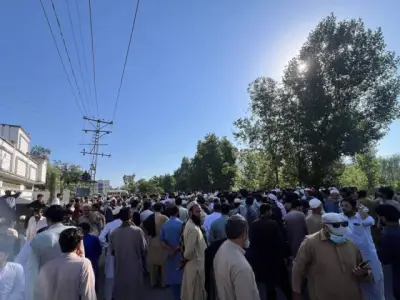
Gilgit-Baltistan and Azad Jammu and Kashmir have recently been in the spotlight for both positive and negative reasons. Gilgit-Baltistan experienced unrest earlier this year when protests erupted in support of Iran. Persistent grievances include demands for rights and a fair share of resources from the common pool. Until a few years ago, this autonomously administered region had also become a haven for militants, undermining social cohesion in an area of immense tourist interest. An effective counterterrorism effort restored calm, though the threat remains. Gilgit-Baltistan has held elections for its representative assembly this week, a positive step toward ensuring that people manage their affairs through chosen representatives, which should provide some relief.
Azad Jammu and Kashmir has also been in turmoil. It has an elected representative assembly to manage its affairs, and while it retains its symbolic status as the seat of all Jammu and Kashmir, including the region illegally occupied by India, it depends on the Government of Pakistan to fund its development and functioning. Lately, it has been demanding rights similar to those of any other province, where all representation comes through the electoral process without nominations by the federal government in Islamabad. The twelve seats contested within Pakistan for émigré Kashmiris from Indian-occupied Kashmir are a point of contention, with allegations that Islamabad exerts undue influence on the assembly's composition through a separate electorate from mainland Pakistan.
Both regions remain economically underdeveloped despite being socially vibrant and progressive. This equation needs to be reversed. The Pakistani state has imposed self-restraints in the hope of a final solution on Kashmir, which Pakistan rightly insists is a dispute reinforced by numerous UN Security Council resolutions. However, neither India nor the UN has made substantial progress toward resolving the issue, which has now become a legacy issue — a euphemism for a lingering dispute between quarreling neighbors. India has incorporated Indian-administered Jammu and Kashmir into its structure as a regular state, dismissing any pretense of special rights requiring resolution. While this does not remove the disputed tag, India hopes that time and resources will mollify residual sentiment for independence. India has divided Kashmir into parts, established new residency rules, and is moving to merge the disputed region completely through political and demographic gerrymandering. Recent state and national elections in Indian-administered Kashmir did not register a protest vote.

Resident Kashmiris in Azad Jammu and Kashmir hold similar aspirations, but the Government of Pakistan, fearing dilution of the Kashmir issue through formal incorporation of the region into mainland Pakistan, has refrained from such a move. There is logic to Pakistan's stand, as it has long advocated for a plebiscite based on the aspirations of the Kashmiri people and individual rights. However, there is an equal need to ensure that the part aligned with Pakistan within the disputed region is administered in an exemplary manner. Currently, this is not the case. There should be a more formal engagement of the federation with these regions to ensure equal rights and resource allocation for both Gilgit-Baltistan and Azad Jammu and Kashmir. This is only possible if the status of these autonomously administered regions is changed to two regular provinces through substantive structural correction.

It is time for the federation to rethink its strategy on both the two provinces and the larger Kashmir issue. Passive acquiescence does not and will not deliver different outcomes. Necessary provisions can be made in the Constitution to enable a review whenever the larger issue of Kashmir and adjoining areas is finally settled. China, while not a recognized party to the Kashmir dispute, has its own claims on Ladakh, areas adjoining Tibet, and the Aksai Chin, part of which borders Gilgit-Baltistan. Pakistan ceded that part to China in a border agreement in 1963. The remaining Aksai Chin is under Chinese control, requiring settlement between China, India, and Pakistan when the larger Kashmir issue is resolved. This explains Pakistan's caution regarding Gilgit-Baltistan, given its special relations with China. But if residents of regions under Chinese and Indian control are given due rights and opportunities as regular citizens, Pakistan should make an equal effort to facilitate and enable the people under its administration.
Creating two additional provinces would require a wholesale review of the Constitution, permitting changes relevant to current needs. This would inevitably involve tinkering with the federation's structure, fiscal distribution, and the balance between federal and provincial authority. Such changes would help remove unnecessary mental blocks and open clauses for review. A constitution must enable effective governance, not obstruct it. Pakistan suffers from inadequate and ineffective governance without accountability. The 18th Amendment has given rise to quasi-federal centers of authority, causing rough edges in federal-provincial relations. The lack of a cohesive approach to common issues that blight ordinary people's lives results in their alienation. A review of the structure and fiscal shares would help soothe such sentiments.
The provinces are too large to be centrally controlled from provincial headquarters. Just as the 250 million population cannot be administered from Islamabad, provinces with 120 million people and one-third the size of the country are ungovernable from one location alone. Local governments under Article 140A have been denied by provincial governments for fear of losing authority and control of resources to lower tiers. Instead, four huge centers of power have emerged, which have magnificently failed at effective governance, service delivery, and ensuring basic rights to citizens per the basic tenets of the Constitution. It is time for them to be cut to size. Otherwise, the failure of Balochistan to ensure security to its citizens, the state of Karachi, the lack of health and education for the people, and inattention to remote regions will continue to manifest in collective failure to govern effectively. Showpiece projects cannot replace wider service delivery and people's rights.
The 18th Amendment was meant to be an enabler, not a disabler. Unless we recognize how badly it has halted progress, we will continue to be administratively dysfunctional while the population becomes increasingly disenfranchised. Pakistan today is facing the consequences of its disabilities. It needs a desperate course correction through structural readjustments.