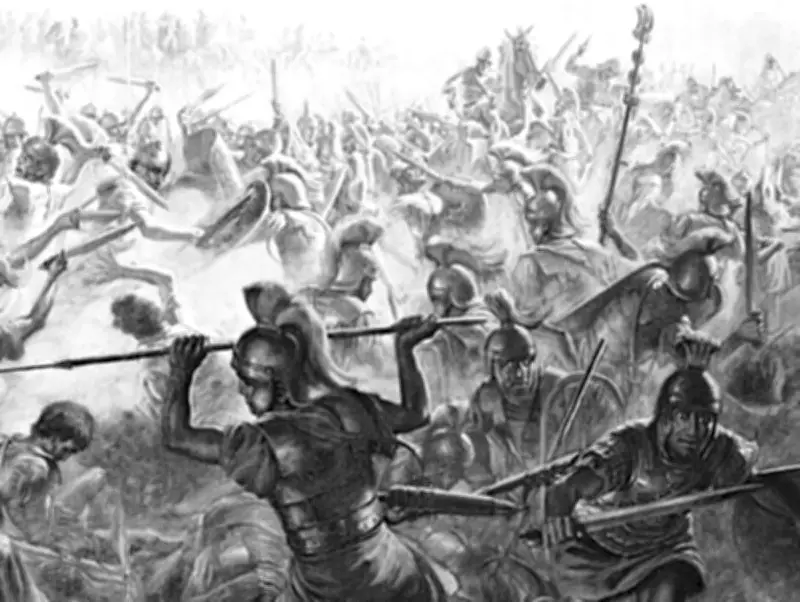
The Battle of Cannae, a pivotal clash in 216 BC between Carthage led by Hannibal and Rome, stands as a masterpiece in tactical warfare. Hannibal, with cunning strategy, executed a brilliant double-envelopment maneuver, encircling the Roman army. Despite Roman numerical superiority, Hannibal's calculated use of his smaller force resulted in one of history's most devastating victories. The Carthaginians' skillful execution led to a catastrophic defeat for Rome, with estimates suggesting over 50,000 Roman soldiers fell. Cannae remains a testament to the importance of strategy and tactical innovation, showcasing Hannibal's military genius and forever altering the course of ancient Mediterranean history.
Strategic Context and Prelude
The Second Punic War had been raging since 218 BC, with Hannibal crossing the Alps and achieving stunning victories at Trebia and Lake Trasimene. Rome, desperate to halt his advance, assembled a massive army of over 80,000 men under the command of consuls Lucius Aemilius Paullus and Gaius Terentius Varro. Hannibal, with a smaller force of about 50,000, camped near the town of Cannae in southeastern Italy, choosing a flat plain that favored his cavalry.
The Deployment
Hannibal arranged his troops in a crescent formation, with the weakest center composed of Gauls and Iberians, and strong African infantry on the flanks. His cavalry, including Numidian light horse and heavy Spanish and Gallic cavalry, was positioned on the wings. The Romans, confident in their numerical advantage, deployed in a deep, dense formation typical of their tactics, aiming to break through the Carthaginian center.

The Double-Envelopment
As the battle commenced, the Roman infantry pushed forward, driving into the Carthaginian center. Hannibal's center gradually withdrew, luring the Romans deeper. Meanwhile, his cavalry on the wings routed the Roman cavalry, then circled behind to attack the Roman rear. The African infantry on the flanks advanced, squeezing the Romans from both sides. The result was a complete encirclement, with the Roman army trapped and slaughtered.
Aftermath and Historical Significance
The defeat at Cannae was catastrophic for Rome. An estimated 50,000 to 70,000 Romans were killed, along with many senators and nobles. Hannibal's victory, however, did not lead to an immediate end to the war; Rome refused to surrender and eventually prevailed under Scipio Africanus. Nevertheless, Cannae remains a timeless lesson in military strategy, studied for its perfect execution of the double envelopment. It demonstrated that superior numbers alone do not guarantee victory, and that tactical brilliance can overcome overwhelming odds.