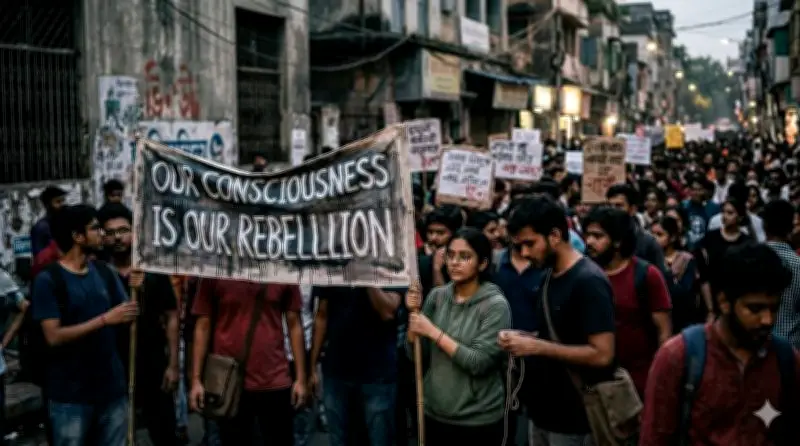
Throughout history, the world has witnessed numerous revolutions driven by the force of reason. People have united around credible, shared understandings built on rational conviction. Historically, as revolutions have responded to the obstacles that block social mobility, the agents of change have consistently been the youth on the ground, in the streets, whether in the American Civil Rights Movement, the Arab Spring, or the Vietnam War protests. Pre-digital generations always carried a pragmatic orientation toward social change. The participants did not merely advocate for the world they wanted; they inhabited it. Throughout their struggles, they committed to a single, unwavering idea. Revolutions of the past strove hard to gain recognition for that idea and to build organisational depth.
For most of human history, the resistance was formidable: churches, trade unions, mosques, and neighbourhood assemblies all served as gatekeepers of collective action. These social institutions excelled at both coordinating effort and filtering out the casually sympathetic from the truly committed, those willing to pay a real personal price for change through physical participation. In a world always defined by its divisions, a universal idea for change can briefly illuminate and synchronise like-minded thinkers.
Tech-native generations have transformed the mode of political expression, but often at the cost of viral outrage replacing sustained, system-changing mobilisation. The Fourth Industrial Revolution has dissolved practical borders and submerged disparate societies into a single global village, complicating the very approaches through which change is pursued. Even so, recent history has produced instructive exceptions.

The Indian Farmers' Protest of 2020
The Indian Farmers' Protest of 2020 — a working-class, agrarian movement struggling for basic livelihoods fell victim to draconian laws introduced by the Bharatiya Janata Party (BJP). As one account noted, "since November, tens of thousands of farmers, or kisans, have surrounded India’s capital, New Delhi, forming a Kisan [Farmers’] Commune." That mass protest compelled the state to repeal the unjust laws. The broader agrarian movement continued to demand a guaranteed Minimum Support Price (MSP), loan waivers, and pension schemes for farmers. Crucially, the protest defied the spirit of the technological moment by maintaining a unified, unbroken consciousness throughout the execution of its demands — a determined resonance with the tradition of communal struggle that echoes the Paris Commune, a foundational model of collective resistance.
This recent history reveals that a generation aggrieved by technological disruption rather than empowered by it is, paradoxically, more insulated from the war of online narratives. Narrative warfare breeds hate, and hate is especially dangerous in a diverse, multi-ethnic, multi-religious country like India. Historically, the subcontinent has witnessed the devastating consequences of religious extremism and ethnocentrism. What has often remained obscure is the hidden hand that stokes such misfortune for political gain.
The Bangladesh Uprising of 2024
The recent ouster of Bangladeshi authoritarian leader Sheikh Hasina in the summer uprising of 2024 offers a contrasting case. The protest was initially ignited by demands to abolish the quota system in civil services — a system that reserved positions for relatives of veterans of the 1971 Liberation War. However, the protesters’ demands rapidly drifted from systemic reform to the toppling of the government itself. As CNN reported, inside Bangladesh, the movement was dubbed "a Gen Z revolution, a protest movement that pitted mostly young student demonstrators against a 76-year-old leader who had dominated her nation for decades and turned increasingly authoritarian." In the wake of the successful removal of the authoritarian regime, the movement’s protagonists endorsed Nobel Peace Prize laureate Muhammad Yunus as head of the interim government.

This abrupt shift in the movement's goals and the absence of a structured plan for what followed is a defining characteristic of tech-native revolutions. Because the base of support is largely an online diaspora, most such groundswells gain enormous momentum in the digital space, and there they also perish. Only those that develop genuine political organisation survive long enough to achieve their stated objectives.
The Cockroach Janta Party Phenomenon
A similar pattern emerged with the Cockroach Janta Party (CJP) in India, which went viral on social media within a fortnight of Chief Justice Surya Kant’s controversial remarks. While hearing a case, the Chief Justice stated, "There are youngsters like cockroaches, who do not get any employment or have any place in the profession. Some of them become media, some of them become social media, RTI activists, and other activists, and they start attacking everyone." According to the Chief Justice, his remarks targeted what he saw as organised fraud, fake and unprofessional conduct in journalism and activism. The youth, however, received these words as a direct attack on their dignity.
The viral "cockroach" political parody group that emerged in response has since been subjected to geo-fencing. Despite functioning as an online campaign rather than a formally registered political party, it has drawn the full wrath of the state. But who, precisely, are these self-described cockroaches? Are they Nietzsche’s moral cockroaches, creatures among butterflies, killable without guilt? Are they Kafka’s existential cockroaches, unrecognised, withdrawn, and alienated from the world that produced them? Or are they simply young, reluctant cockroaches who resist being reduced to vermin by those in power?
The BBC described the group’s online mandate as "the voice of the lazy and unemployed," with tongue-in-cheek membership criteria that include being chronically online and possessing "the ability to rant professionally." It is a mixture of frustrated youth, sardonic, politically aware, and deeply unserious in form, even when deadly serious in grievance.
The Challenge of Sustained Change
Yet such social mobilisations remain vulnerable to capture by established opposition forces, actors resistant to any change that does not serve their own interests. Most contemporary revolts have ultimately installed a new cast of characters within the same old system, despite extraordinary sacrifices. The careful distinction between casually sympathetic participants and deeply committed ones is essential to shifting political energy from screens to streets. A pragmatic, embodied approach to change remains far more durable than virtual narrative-building alone. The new modes of revolution pioneered by Gen Z are, as things stand, far more likely to ignite turmoil than to achieve their objectives.