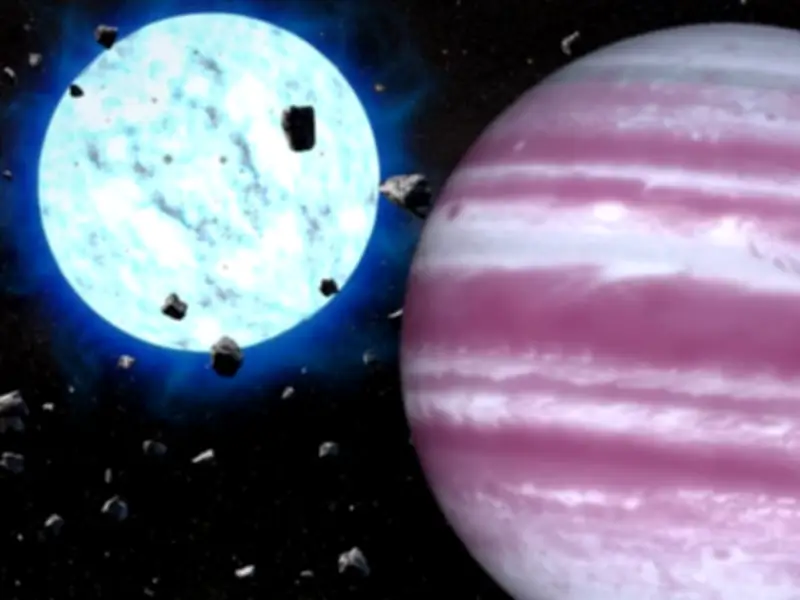
Astronomers have conducted detailed observations of a Jupiter-like exoplanet that survived the death of its sun-like star, providing new insights into how some planets endure the dramatic transformation of their host stars. The planet, designated WD 1856 b, is located 81 light-years from Earth in the constellation Draco. Researchers report that it has survived for billions of years after its host star exhausted its fuel, shed its outer layers, and became a white dwarf—the dense stellar remnant left behind after a sun-like star dies. The findings also offer clues about the possible fate of planets in our own solar system when the Sun reaches the end of its life in about five billion years.
Key Characteristics of WD 1856 b
Researchers determined that WD 1856 b has a mass about eight times that of Jupiter, the largest planet in our solar system. Its atmospheric temperature is approximately 260 degrees Fahrenheit (127 degrees Celsius), making it unexpectedly warm. The gas giant now orbits extremely close to the white dwarf, at a distance about 50 times closer than Earth is to the Sun, completing one orbit every 1.4 days after apparently migrating inward over time.
Survival Against the Odds
Scientists said the planet demonstrates that some worlds can survive the death of their host stars, although the conditions surrounding WD 1856 b differ from those expected for any surviving planets in the solar system. The planet exists in an unusual gravitational environment because the white dwarf is part of a triple-star system that also includes two red dwarf stars, each with about 30% of the Sun’s mass.

Migration Theories
Researchers are trying to determine how the planet reached its current orbit. One theory suggests the planet was engulfed by its host star during its expansion into a red giant but survived just outside the stellar core that later became the white dwarf. This scenario could explain how a giant planet ends up so close to a white dwarf, providing a potential analog for the fate of planets in other systems.