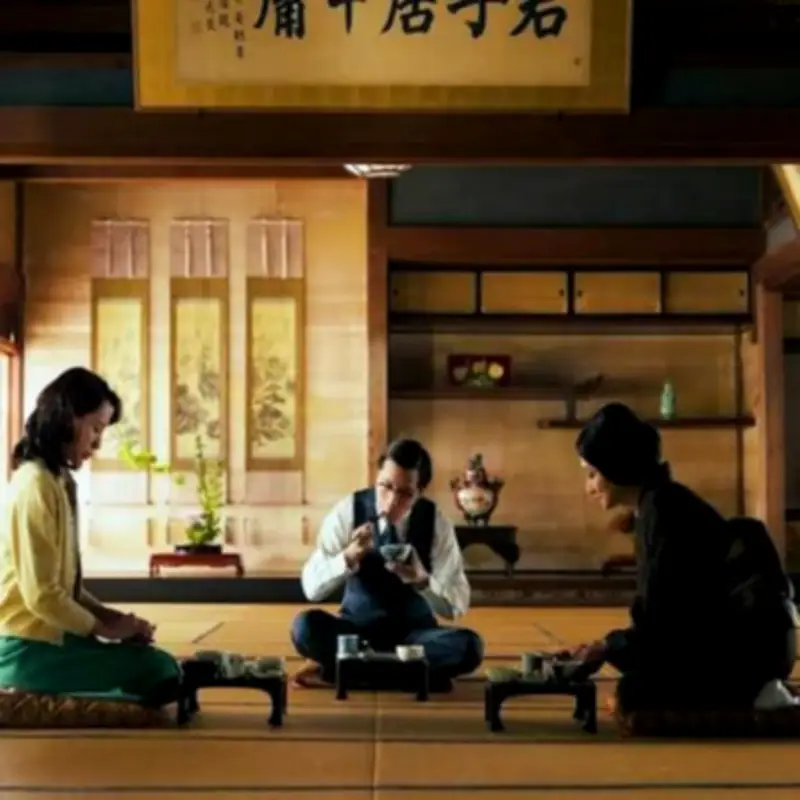
Netflix's latest Japanese prestige series Straight to Hell is a biographical drama that transcends the mere retelling of historical facts and becomes something transcendent—a tapestry of psychological ambition and cultural evolution. Masterfully directed by Norichika Oba and Tomoyuki Takimoto, and penned with elegance by Manaka Monaka, the series chronicles the meteoric, scandalous, and utterly mesmerising life of Japan's most infamous and controversial fortune teller Kazuko Hosoki.
Rags, Scams, and Riches
At its core, Straight to Hell is an epic chronicle of reinvention. A fictional journalist, Minori Uozumi (played with grounded scepticism by Sairi Ito), interviews an older, fiercely guarded Kazuko Hosoki for a definitive biography. As Minori digs beneath the polished, glamorous exterior of the legendary fortune teller, the series plunges the audience into the past, tracing Hosoki’s journey from the ashes of World War II to the neon-drenched heights of Tokyo’s nightlife.
The story begins in the destitution of post-war Tokyo. We meet Kazuko as a young girl in a tattered red dress, scurrying through a war-devastated landscape, starved and desperate. Her family is barely surviving, and she feeds her younger siblings first when she gets a chance and ignores her empty stomach. The battle for survival lights in her the fiery obsession to acquire wealth at any cost. As she grows into a daring, resourceful young woman, the series charts her rapid, chaotic ascension in society.

Japan Rises from the Ashes
One of the most brilliant and thematic achievements of Straight to Hell is the way it seamlessly parallels Japan’s post-war macro-transformation with Kazuko’s micro-evolution. The series treats the setting not merely as a backdrop, but as a secondary character that directly shapes the protagonist’s moral compass. In the early episodes, the visual palette is stark, desaturated, and heavy with the weight of a country in trauma.
As the decades progress, the show undergoes a breathtaking visual and narrative evolution that mirrors the country’s volatile economic miracle. The rubble gives way to the monumental architectural and societal boom of the 1964 Tokyo Olympics. The series captures this era of global rebirth; as Japan reintroduces itself to the world stage as a modern, high-tech powerhouse, Kazuko rides the wave of optimism, transforming from a street-level survivor into an opulent nightclub mogul catering to the newly rich elite.
A Complex and Fascinating Heroine
Erika Toda delivers an unforgettable performance as Kazuko Hosoki. Toda achieves the feat of playing the character across vastly different eras of her life, executing a portrayal so nuanced that it leaves the viewer utterly spellbound. The contrast Toda depicts between the young and old versions of Kazuko is so stark that the two versions look and feel entirely distinct. However, they are psychologically continuous.
In her youth, Kazuko is portrayed as an endearing, charismatic, and resourceful underdog. Despite her growing capacity for manipulation, Toda plays her with a vulnerability that makes it impossible not to root for her. The older depiction is a chillingly different creature. As the decades wear on and the wealth accumulates, the warmth completely evaporates from Kazuko's face. The older woman is a formidable and deeply cynical media mogul.
The Yakuza and the Layered Society
No story about the rise of Tokyo's post-war entertainment and financial sectors would be authentic without addressing the criminal underworld, and Straight to Hell handles the intermixing of the Yakuza with an uncompromising eye. Mid-series (particularly from Episodes 4 through 7) the show takes a deep dive into the treacherous waters of the yakuza-backed nightlife. Kazuko’s ascent as a nightclub owner forces her into complex power dynamics with powerful syndicates.
Masaya Hotta (played with a magnetic charm by Toma Ikuta) serves as the perfect conduit for this world. Through his interactions with Kazuko, the series explores how she learns to navigate, manipulate, and occasionally outsmart men who hold the literal power of life and death over her. The Yakuza are not presented as stylized movie villains, but as deeply entrenched institutional forces.

Seamless Flow
With a story that spans over half a century and tackles post-war ruin, yakuza thrillers, corporate espionage, and media satire, Straight to Hell should, by all accounts, feel disjointed. Yet, nothing feels out of place. The screenplay exhibits a flawless narrative architecture. The transitions between the historical eras and the modern-day journalistic investigation are seamless, with each era feeding thematic information into the next.
Visually, the series is an absolute triumph. Cinematographers utilise distinct colour profiles and camera movements for each era—the vibrant, saturated tones for the nightlife boom eras will stay with you after you’ve turned your TV off. The costume design alone, particularly the evolution of Kazuko’s striking wardrobe, tells a story of power, opulence and impeccable elegance.
What elevates Straight to Hell to the upper echelon of television is its refusal to offer moral platitudes. The show does not excuse Kazuko’s predatory scams, nor does it ask the audience to absolve her. The ending deliberately avoids the comforting cliché of total ruin and cosmic justice; instead, it reflects the messy, cynical reality of the world she conquered. Kazuko Hosoki adapts, survives, and ultimately thrives, capitalising on the digital age just as she did the television era.