Samsung Galaxy S26 Ultra's Privacy Display Earns High Marks in Detailed Review
In an era where hardware innovation often feels stagnant, the Samsung Galaxy S26 Ultra's new Privacy Display has emerged as a standout feature, leaving reviewers thoroughly impressed. This technology, designed to restrict the screen's viewing angle and thwart potential onlookers, represents a significant advancement in smartphone privacy, even though it's not entirely novel, having been previously seen in laptops.
How the Privacy Display Works and Its Practical Impact
The Privacy Display operates through a dual-pixel system: one set projects images directly toward the viewer, while another emits light to the sides. By deactivating the side-projecting pixels, the screen maintains normal visibility for the user but appears dim and unreadable from an angle. This effect is more pronounced from the sides rather than directly behind, though determined peepers might still catch a glimpse. Users can toggle this feature on or off, and there's an enhanced setting for maximum privacy assurance.
During testing, activating the Privacy Display from an angle noticeably reduced contrast, making text challenging to read, which underscores its effectiveness. In true Samsung fashion, the feature is highly customizable. It can be configured to obscure only notifications, activate automatically during PIN entry or specific app use, and integrate with routines—for example, turning off at home and on when leaving.

Additional Hardware and Design Updates
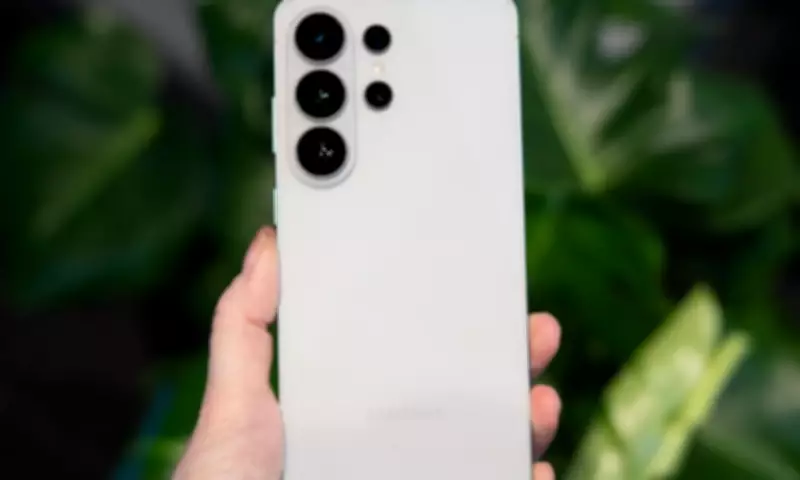
Beyond the Privacy Display, the Galaxy S26 Ultra introduces subtle yet meaningful hardware changes. The phone is now slimmer and lighter, measuring 7.9mm thick (down from 8.2mm) and weighing 214 grams (reduced from 218 grams). This weight reduction partly stems from a switch back to aluminum from titanium, aligning with industry trends. Design-wise, Samsung has unified the Ultra's aesthetics with the standard S26 and S26 Plus models, eliminating any remnants of the boxy Note look and adopting consistent curvature around the corners.
Notably, the camera system receives an upgrade with brighter lenses: the main 200-megapixel lens improves from f/1.7 to f/1.4, and the 50-megapixel 5x zoom lens enhances from f/3.4 to f/2.9. These adjustments promise better low-light photography by allowing more light to reach the sensor.
AI Integration and Software Enhancements
The S26 Ultra also embraces artificial intelligence with features like natural language generative photo edits in the gallery app, similar to Google Photos. Users can input multimodal prompts, such as blending images to create AI-enhanced photos. Additionally, the phone will be among the first to offer an agentic Google Gemini assistant, initially focused on ridesharing and grocery shopping apps. This AI can operate in the background or be monitored and interrupted by the user, marking a step toward more autonomous AI systems.
Other software updates include Pixel-like features such as Now Nudge, which provides contextual prompts in the keyboard, scam detection for calls, and AI call screening for unknown numbers. Bixby has also been improved to offer better natural language assistance for phone settings.
Performance and Pricing Details
Globally, all versions of the S26 Ultra will feature the Snapdragon 8 Elite Gen 5 chipset, optimized specifically for Samsung. Despite economic challenges like RAM shortages and inflation, the price remains unchanged at $1299 for the 256GB storage and 12GB RAM model, offering consumers a consistent cost amid rising market pressures.
Overall, the Galaxy S26 Ultra's Privacy Display, combined with its camera upgrades, AI capabilities, and refined design, positions it as a compelling option in the competitive smartphone landscape, particularly for users prioritizing privacy and cutting-edge technology.