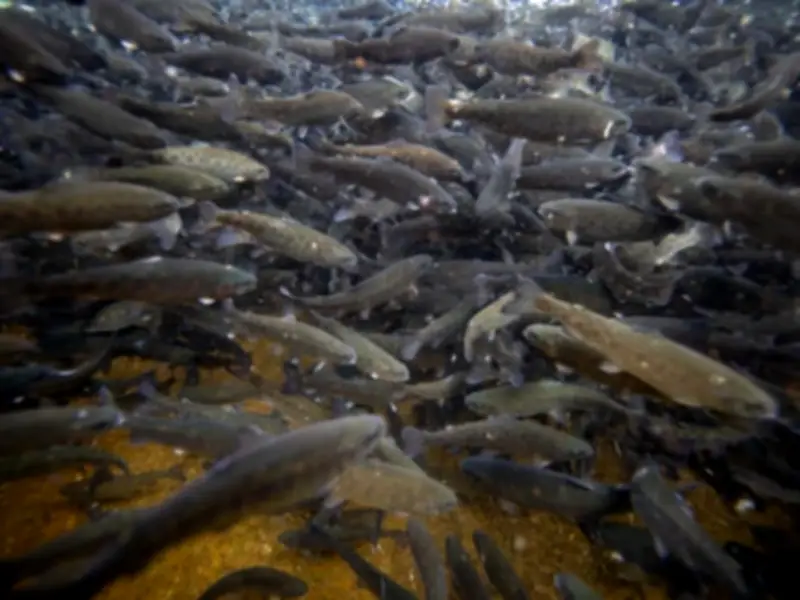
Gilgit-Baltistan (G-B), renowned for its towering peaks, vast glaciers, and pristine lakes, is witnessing a sharp decline in its prized trout population. Climate change, habitat loss, and overfishing are the primary threats to this species. The icy, glacier-fed waters of G-B provide an ideal environment for trout breeding, making it one of Pakistan's most valued freshwater fish. However, in recent years, the trout population has drastically reduced due to a combination of climate and human-induced factors, including habitat fragmentation, pollution, hydropower projects, and most notably, overfishing.
Drastic Decline in Trout Numbers
According to experts and officials, the trout population has been slashed by 50% over the past two decades. Farasat Ali, an official of the Worldwide Fund for Nature (WWF) Pakistan, stated that climate change-induced flash floods have been destroying spawning habitats in most streams and tributaries by altering sediments and gravel size. He noted that while local rivers and streams remain in good condition, overfishing through dynamite, nets, and electric shocks poses serious challenges. Hydropower stations also hinder trout migration and life cycles, as most projects in G-B lack fish ladders or bypass systems for fish movement. Trout naturally migrate upstream for breeding, and without such provisions, entire populations of offspring can be lost in the same habitat.
Impact of Climate Change and Floods
Inayat Ali, an assistant director at G-B's Fisheries Department, emphasized that dramatic climate change, particularly regular floods since 2010 and glacial lake outburst floods (GLOF), has severely impacted the trout population. Trout require fresh, clean water with high oxygen levels to survive and grow. Floods and landslides introduce mud and rocks, spoiling water quality and destroying breeding grounds. Improved road infrastructure has also contributed to overfishing by providing access to remote areas, boosting commercial catching.

Reduction in Fish Size
Not only has the number of trout declined, but their size has also decreased over time, reflecting the adverse effects of overfishing. It is now rare to catch a trout weighing above 1 kilogram; most are between 500 and 600 grams. A decade ago, catches of 2 kilograms or more were common. Although no official surveys exist, conservative estimates suggest a 50% decline in trout numbers over the past two decades, a figure endorsed by Khadim Hussain, a local environment protection agency official. Hussain cited improved road and transport infrastructure as a key factor behind overfishing and commercial catching.
Historical Introduction of Trout
Trout is not native to G-B; it was introduced by British colonial officers in the late 19th and early 20th centuries. This exotic species has displaced many native fish species in rivers and streams. G-B is home to two kinds of trout: brown trout and rainbow trout, with brown trout being more abundant. The picturesque Ghizer district is known as a hub for trout. Fishing is banned from October to March, a six-month breeding period, though the ban is often violated. Obtaining a fishing license is mandatory, and the fisheries department now issues 5,000 to 6,000 seasonal and daily licenses annually, compared to 1,000 to 1,500 a decade ago.

Booming Trout Farming Industry
Increasing demand for trout has led to a booming trout farming industry across the region. While trout numbers in rivers and lakes are decreasing, farming is on the rise. In the past three to four years, the number of trout farms has soared to over 450, up from barely 100, supplying around 600 tons of trout yearly across Pakistan. Since 2013, the fisheries department has provided guidance and financial assistance for trout farming, which has become a lucrative business, opening up new employment opportunities. Maaz Alam, who established a trout farm in Ghizer district in 2017, currently supplies 10 tons of fish annually to Islamabad, Lahore, Peshawar, and other cities, with increasing demand and profits. He reports an 80% to 100% return on investment in trout farming. A bulk of the production is consumed domestically due to a surge in local tourism. No tourist leaves without tasting trout, which has become a hallmark of G-B. Alam believes the region has potential to export trout to regional nations, particularly the Middle East, but requires proper marketing and high-quality packaging, which cannot be achieved without government or third-party support.
Proposed Conservation Measures
Farasat Ali called for community-based fish conservation and management, similar to trophy hunting programs, to boost the dwindling trout population. A sustainable trophy hunting program and greater community involvement have already helped Pakistan maintain an increasing population of its national animal, the markhor. The G-B government auctioned permits to hunt endangered markhor for a record $370,000 last year, one of the highest permits globally. The funds support local communities through schools, mosques, health centers, and scholarships. About 80% of the amount generated from the hunting license program, launched in the early 2000s, is spent on local communities, while the remainder goes to the national exchequer. Farasat believes this formula could boost fish populations and wetland conservation in specific areas.