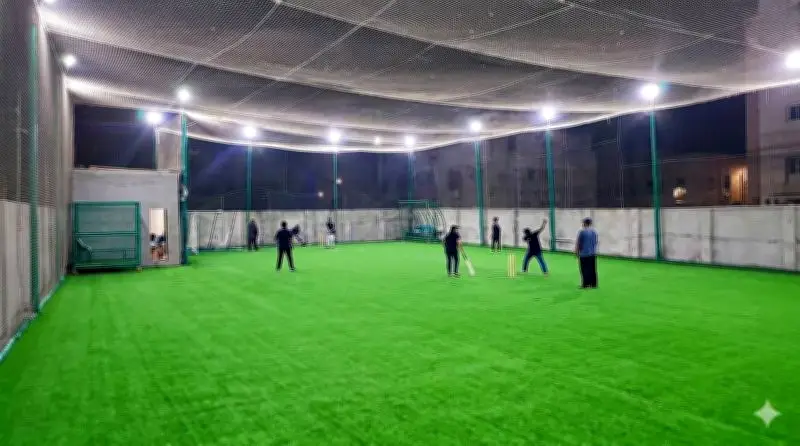
Walk through any dense residential locality in a Pakistani city after Maghrib, and you will hear it before you see it — the thwack of a tape ball against a taut nylon net, laughter from a rooftop, the faint green glow of polypropylene turf under a halogen bulb. These are the country's newest small businesses, filling a void that rapid urbanisation created and public policy has mostly failed to address.
Urbanisation Outpacing Public Amenities
Pakistan is urbanising faster than almost anywhere in South Asia. The 2023 census put the national urbanisation rate at 38.8 per cent, up from 36.4 per cent in 2017, with the urban population growing at 3.67 per cent annually, Punjab recording 4.24 per cent per year. Between 1998 and 2017, the urban population nearly doubled, from 43 million to 75 million; the UN projects it will cross 118 million by 2030.
Cities have expanded; recreational space has not kept pace. In Lahore, open spaces fell from 31.09 km² in 1998 to 15.69 km² by 2018 — that is nearly 50 per cent gone in two decades. A 2025 AKU–NYU study found Karachi at just 4.17 m² of green space per capita, less than half the WHO minimum of 9 m². Across Rawalpindi, Faisalabad, Multan, and Peshawar, the pattern repeats: cities that grew by consuming the plots where children once played tape ball.

The PIDE BASICS Notes showed that almost 60 per cent of Pakistanis do not have access to playgrounds or areas. Cricket in Pakistan was never played in stadiums. A Gallup Pakistan survey revealed that over half of the country considers themselves cricket fans, which is an undercount as the country's fandom is not passive. Whether you are in Quetta, in the katchi abadis of Karachi, or in the housing colonies of Punjab, you play cricket in a free evening. The plots which were used to be playgrounds have been sold or developed. The desire to play has not been satisfied.
Asset-Light Model Fills the Gap
The model is also asset-light in a way that is never achieved by formal sports infrastructure economically. Someone puts down a roll of polypropylene grass on a roof, anchors a steel frame, ties a net, installs some LEDs and starts accepting reservations. The lane costs Rs 1,500 to Rs 3,500 per hour and is booked well in advance during the evening hours. These arenas are found in clusters in Lahore, Karachi, Islamabad, Rawalpindi and Faisalabad, with many of the arenas in these cities now hosting futsal and badminton along with cricket nets.
It is not by chance because the timing is perfect. A culture has emerged in Pakistan, in the cities, where offices close at 6–8, and young men in their twenties or thirties have an hour to fill. They were raised on the game of cricket through watching it on a neighbour's television or playing cricket in a plot that was transformed into a plaza. They do not want to be in a formal setting with membership requirements, but rather an hour with five friends. Net cricket fits into that space like a jigsaw puzzle.
The model is also asset-light in a way that is never achieved by formal sports infrastructure economically. No land purchase, no municipal dependency. Entrepreneurs turn rooftops that require investment into recurring revenue. Synthetic turf and steel frames last for years; labour requirements are low; working capital is low. This is not planning but a need, where public spending has gone to elites' facilities or government grounds, which most residents cannot afford.
Market Signal for Policymakers
The base deficit is unchanged. A rooftop net is not a public ground. If a child is not able to pay Rs 300 a head, he or she is still underserved. However, this boom is a market signal that is easy to read: “If public provision is not provided for long enough, people stop waiting.” Now the question is: will it be read as a sign, or will policymakers wait for the next rooftop to fill?