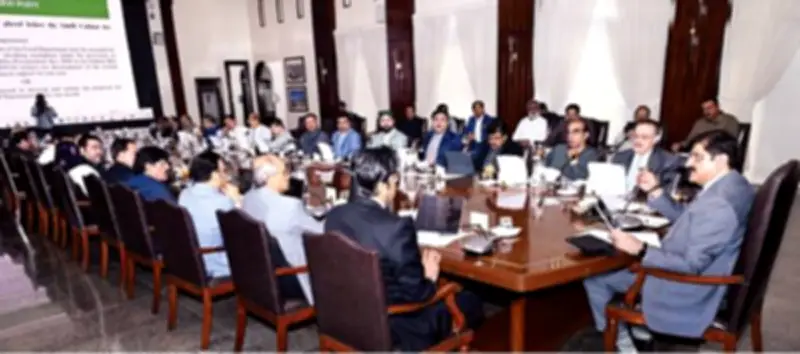
The Sindh Cabinet, chaired by Chief Minister Syed Murad Ali Shah, convened on Tuesday for a landmark policy session focusing on agriculture, food security, and rural development. The cabinet approved the Sindh Farmers’ Agricultural Collectives Act, 2026, ordered strict action against wheat hoarders, initiated reforms to digitise the provincial Food Department, and reviewed the draft National Wheat Policy 2026–2030. The meeting also addressed inclusive education, prison security, revenue reforms, infrastructure development, welfare of Rescue-1122 personnel, fisheries monitoring, and the extension of Pakistan Rangers’ deployment in Sindh.
Sindh Farmers’ Agricultural Collectives Act, 2026
The cabinet cleared the final draft of the Sindh Farmers’ Agricultural Collectives Act, 2026, paving the way for its introduction in the Provincial Assembly. The legislation aims to empower small farmers, livestock breeders, and fisherfolk by enabling them to pool land, resources, and machinery, improve access to finance and technology, and connect directly with high-value markets. Developed after consultations with farmers’ organisations, the Sindh Chamber of Agriculture, the Sindh Abadgar Board, and the State Bank of Pakistan, the bill establishes a legal framework for collective farming and agribusiness. It defines small farmers as those owning or cultivating between one and 25 acres and extends the concept to livestock and inland fisheries. The legislation introduces a democratic governance structure based on "one member, one vote," mandates representation of women and transgender persons, creates transparent profit-sharing mechanisms, and opens opportunities for participation in carbon-credit and ecosystem-services markets. For regulation, it proposes the Sindh Agricultural Collectives Regulatory Authority to register and supervise collectives, provide digital governance platforms, facilitate e-commerce linkages, manage climate and pest risks, and resolve disputes. The government believes the initiative will promote mechanisation, strengthen farmers’ bargaining power, reduce dependence on middlemen, and support climate-smart agriculture.
Crackdown on Wheat Hoarding and Food Department Digitisation
The cabinet was informed that Sindh faces a projected wheat deficit of 1.59 million tonnes during 2026-27, while wheat prices in the open market have risen significantly above the official support price of Rs3,500 per 40 kilograms. The food department reported that flour mills, traders, and private stockists were holding substantial wheat stocks, contributing to speculation and price increases. In response, the chief minister decided to launch a crackdown against hoarding to stabilise flour prices and protect consumers. As part of broader reforms, the cabinet considered an Integrated Wheat Management System to digitise procurement, storage, transportation, and issuance of wheat across Sindh. The Science & Information Technology Department endorsed the initiative and recommended involvement of the Sindh Information Technology Company (SITC). The chief minister directed the Food Department to move rapidly towards digitisation, enhance transparency, and adopt modern commodity-management practices. He also emphasised greater private-sector participation in wheat operations and called for gradually transforming the Food Department into a lean, technology-driven regulatory body focused on policy, oversight, and food security. Chief Secretary Asif Hyder Shah said that digitisation of the food department was part of the reform package.


National Wheat Policy and Sugar Sector Deregulation
The cabinet reviewed the draft National Wheat Policy 2026–2030, circulated by the federal Ministry of National Food Security and Research. The proposed policy seeks to transition from a government-led wheat procurement model to a market-based system, reduce subsidy burdens, encourage regulated private storage, maintain limited strategic reserves, and modernise agriculture through improved seeds, mechanisation, and better inputs. To formulate Sindh’s response, the chief minister constituted a committee comprising the secretaries of Food, Agriculture, and Law to examine the policy and submit recommendations. The cabinet also discussed IMF observations regarding deregulation of the sugar sector and reaffirmed Sindh’s opposition to the establishment of new sugar mills. The province maintained that regulatory authority over licensing, pricing, and oversight should remain with provincial governments while supporting conditional deregulation, phased trade liberalisation, and stronger competition safeguards to protect growers, consumers, and environmental interests.
Fisheries Monitoring and Rescue-1122 Welfare
The cabinet approved amendments to the Sindh Registration and Regulation of Fishing Jetties Rules, 2022, to strengthen monitoring and enforcement along the province’s coastline following the identification of 64 unauthorised fishing jetties. Under the amendments, the Marine Fisheries Conservation Police will be renamed the Sindh Fisheries Security Service, headed by a District Fisheries Conservation Officer, to conduct monitoring, control, and surveillance of marine resources. The cabinet endorsed the already approved expenditure of Rs236.55 million for 300 posts and approved an additional Rs63 million for the purchase of three speed boats to enhance coastal surveillance. Recognising risks faced by emergency responders, the cabinet approved a policy framework providing financial assistance to families of Rescue-1122 personnel who lose their lives in the line of duty. The package includes an ex gratia grant of Rs10 million, burial assistance of Rs300,000, continuation of salary or employment opportunities for next of kin, and a group life insurance cover of Rs5 million. A dedicated Welfare Compensation Committee will determine eligibility and oversee disbursement.
Infrastructure and Education Projects
The cabinet approved completion of the long-delayed Shaheed Mohtarma Benazir Bhutto Flyover Project in Hyderabad through the Works and Services Department. The project, originally launched in 2016-17, had stalled despite significant progress, including construction of 24 bridge girders. The remaining work will proceed after structural validation and compliance with legal and technical requirements. The cabinet also authorised the Department of Empowerment of Persons with Disabilities (DEPD) and Aga Khan University’s Institute for Educational Development to sign a five-year agreement aimed at promoting inclusive education across Sindh. The initiative will establish a Special Education Unit at AKU-IED, train more than 2,000 educators, develop model schools and learning resources, and benefit approximately 24,000 students. The Sindh government will contribute Rs278.56 million, while AKU-IED will provide Rs160.65 million.
Prison Security and Revenue Reforms
The cabinet granted permission to the Inspector General of Sindh Prisons to procure 212 units of Chinese Submachine Guns (SMGs) from the Pakistan Ordnance Factory (POF). The decision resolves a procurement delay dating back to 2016-17, when the prison department initially paid Rs46,394,886 to POF for 535 units of Russian AK-103 rifles. Due to international sanctions on Russia, POF offered Chinese SMGs as an alternative. Due to inflation and a higher per-unit cost of Rs218,820, the original paid amount will cover 212 units. Regarding revenue, the Board of Revenue presented a finalised mechanism for recovery of stamp duty for the lease of 262 acres of land at DHA Karachi, Phase VII Extension. The cabinet confirmed a Deferred Payment Plan to recover the total stamp duty of Rs2,496,532,500. The recovery will span a maximum of three years, divided into six equal bi-annual instalments of Rs416,088,750, commencing in July 2026 and concluding in January 2029.
NED Science & Technology Park and Pakistan Single Window
The cabinet approved a revised financial framework for the NED Science & Technology Park, a flagship Public-Private Partnership project. The project was originally based on obtaining Special Technology Zone (STZ) status and related federal incentives, but could not proceed after new STZ approvals were halted due to IMF-related fiscal restrictions. Under the approved alternative model, the Sindh Government will make a contingent commitment to purchase up to 40 per cent of the project’s unoccupied saleable area at market value, only if occupancy remains below the agreed threshold three years after commercial operations begin. The cabinet also approved necessary amendments to the concession agreement. Additionally, the cabinet approved a new three-year Service Level Agreement (SLA) between the Board of Revenue and Pakistan Single Window (PSW). Following the expiration of the previous agreement with Pakistan Revenue Automation Ltd (PRAL) in 2025, the new agreement covers digital collection of the Rs2,000 stamp duty charged on Bills of Entry. The approved service fee rates (excluding SST) per paid bank challan are Rs40 for 2025–26, and Rs44 for both 2026–27 and 2027–28. The agreement includes safeguards such as real-time monitoring, view-only access integration, and customised reconciliation reports through the E-Pay Sindh platform.
Extension of Rangers Deployment
The cabinet ratified the extension of the deployment of Pakistan Rangers in Sindh for another year, from July 20, 2026, to July 19, 2027, to assist Sindh Police in maintaining law and order.