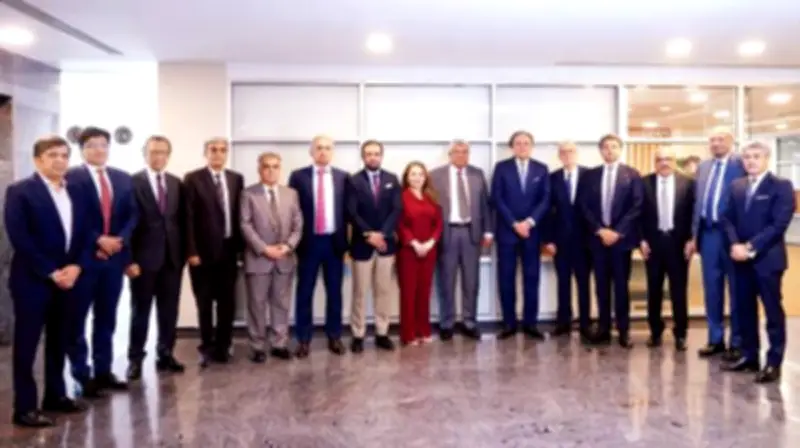
Senator Muhammad Aurangzeb, Federal Minister for Finance and Revenue, accompanied by leading Pakistani entrepreneurs, visited the Arif Habib Group’s head office to discuss the country’s economic outlook, capital markets, investment climate, and the government's reform agenda. The group’s leadership praised the finance minister’s stewardship during a challenging period and acknowledged progress in restoring macroeconomic stability.
Declining Inflation and Improved Indicators
The discussions highlighted a decline in inflation to single-digit levels, a reduction in policy rates, improved fiscal and external sector indicators, strengthening foreign exchange reserves, and renewed investor confidence. Pakistan’s successful progress under the IMF programme and an improved sovereign ratings outlook were recognized as key milestones in rebuilding confidence and laying the foundation for long-term growth.
Capital Market Performance
The meeting noted exceptional capital market performance. Since Senator Aurangzeb assumed office in March 2024, the benchmark KSE-100 Index rose from approximately 65,000 points to over 180,000 points. FY2026 delivered an annual return of about 43.5%, and market capitalization surpassed Rs. 20 trillion. The revival of IPO activity was seen as an encouraging sign of renewed corporate confidence and growing investor participation.

Need for Further Reforms
While acknowledging the positive direction of the federal budget, participants discussed measures to stimulate private investment, create employment, and enhance government revenues. The Special Investment Facilitation Council (SIFC)’s priority sectors—agriculture, mining, infrastructure, and information technology—were identified as key drivers for the next growth phase, emphasizing accelerated investment and implementation.
Construction Sector as a Catalyst
Particular emphasis was placed on the construction sector as a fast avenue for stimulating economic activity. Revitalizing construction would generate immediate employment, utilize idle capacity in allied industries, increase government revenues, and deliver growth without adversely impacting the current account. The meeting also highlighted unlocking the government’s land bank through public-private partnership (PPP) models, with land contributed as equity to catalyze housing and infrastructure development.
Role of REITs
The discussion underscored the importance of Real Estate Investment Trusts (REITs) as transparent, documented investment vehicles to mobilize domestic liquidity into productive sectors, support infrastructure, and broaden investment opportunities. As a pioneer in Pakistan’s REIT sector, the Arif Habib Group reaffirmed its commitment to supporting the government in leveraging REITs and PPPs to unlock investment and create employment.
Quotes from Leadership
Arif Habib, Chairman of Arif Habib Group, said: “The progress achieved in restoring macroeconomic stability has laid a strong foundation for Pakistan’s next phase of growth. The remarkable performance of the Pakistan Stock Exchange and the revival of IPO activity reflect renewed investor confidence. The next step is to translate this stability into higher investment, greater employment and sustained economic expansion. Accelerating development across the SIFC’s priority sectors, while revitalising construction through public-private partnerships and wider utilisation of REITs, presents one of the fastest and most effective opportunities to create jobs, enhance government revenues and unlock Pakistan’s economic potential. The private sector stands ready to partner with the Government in achieving these objectives.”

Senator Muhammad Aurangzeb thanked the Arif Habib Group for its continued contribution and reaffirmed the government’s commitment to maintaining macroeconomic stability, implementing structural reforms, and fostering an investment-friendly environment. “The government remains committed to maintaining macroeconomic stability while implementing structural reforms that strengthen Pakistan’s competitiveness and improve the ease of doing business. Sustainable economic growth will be driven by private sector investment, vibrant capital markets and continued collaboration between government and industry. We value the constructive engagement of institutions such as the Arif Habib Group in supporting Pakistan’s economic development.”
Commitment to Future Engagement
The meeting concluded with a shared commitment to maintain close engagement between policymakers and the private sector to deepen capital markets, encourage productive investment, expand employment, and support long-term economic growth.