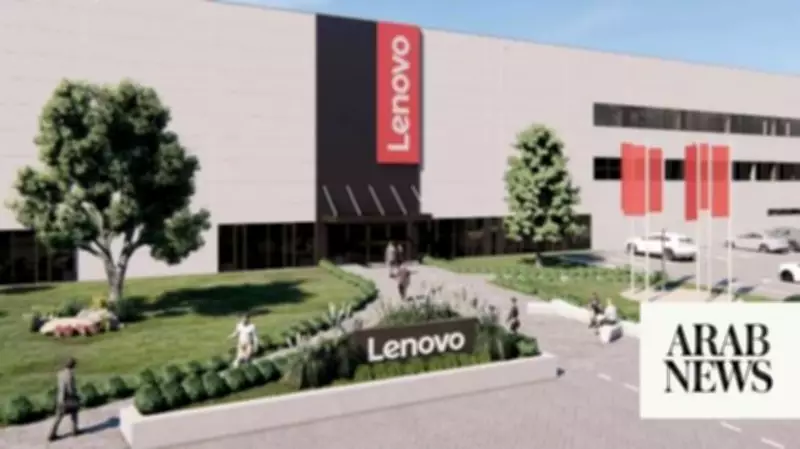
Lenovo is set to achieve a historic milestone in Saudi Arabia as it prepares to launch full-scale commercial production of smartphones, laptops, desktop computers, and data servers from its Riyadh factory in 2026. The announcement was made by Tareq Alangari, president of Lenovo for the Middle East, Africa, Turkiye, and Pakistan, and senior vice president of the group, during an interview with Al-Eqtisadiah.
Investment and Production Capacity
The first phase of the project involves an investment exceeding SR2 billion ($533.2 million). The factory will gradually ramp up production to reach an annual capacity of 2 million units within one-and-a-half to two years. Alangari revealed that the second phase aims to increase capacity to 8 million units annually, contingent on market demand. This could position the facility as one of Lenovo's largest globally, potentially the largest outside China except for one major plant.
Strategic Shift to Riyadh
Alangari emphasized that Lenovo's investment in Riyadh marks a qualitative shift in its business model. The company has transferred its operational and administrative hub to Riyadh, overseeing operations across more than 60 countries. The region managed from Riyadh spans from Pakistan and Afghanistan to Turkiye, the Levant, North Africa, and Morocco, covering a population of over 2 billion people.

The Riyadh factory, spanning 200,000 square meters, is unique within Lenovo's network of around 30 global factories. Unlike traditional facilities that focus on a single production line, this factory integrates four lines: smartphones, laptops, desktop computers, and high-performance data servers. This integration represents a significant operational and investment challenge.
Product Range and Focus
The factory will produce high-end Motorola phones, a wide range of laptops (from high-performance to economy models), desktop computers, and high-compute servers critical for artificial intelligence and digital infrastructure. Alangari noted that the investment of over SR2 billion in the current phase is substantial by industry standards, especially compared to other factories with capacities of only a few thousand or tens of thousands of units.
Operational Flexibility and Competitive Advantage
Alangari highlighted the factory's high flexibility, allowing it to allocate full production lines to meet orders from government entities or major corporations. This flexibility reduces fulfillment time significantly. Manufacturing and shipping from countries like China, the US, or Brazil can take months, but the Riyadh factory shortens these durations, improving supply chain efficiency and customer service in Saudi Arabia and the region.
The positive impact extends to regional and international markets. Alangari noted interest from Turkiye and Gulf countries in having a nearby factory that reduces waiting times, strengthening Saudi Arabia's position as a manufacturing and distribution hub.
Export Platform and Partnerships
The factory is not limited to the local market; it serves as a flexible export platform based on efficiency and delivery speed. Customers in Europe, such as the UK or Germany, could be supplied from Saudi Arabia if delivery speed surpasses other alternatives. Lenovo has deep strategic partnerships with NVIDIA, Intel, AMD, and Qualcomm, including direct collaboration on product development within Riyadh offices.
Ownership Structure
Lenovo is an international, multi-shareholder company with investors from the US, China, Saudi Arabia, and other countries. The Public Investment Fund (PIF) invests through Alat via financial instruments convertible into shares, making it one of the largest potential shareholders. Alangari affirmed this partnership's strategic value.
Full-Scale Production and Workforce Development
2026 will witness a historic event as the first full commercial batch is produced. Following trial batches, supply to customers in Saudi Arabia and exports will commence. The project also focuses on building human capabilities. Saudi engineers are being trained internally and externally, with 27 engineers sent to China as part of a target of 100 in the initial phase. The project is expected to provide thousands of jobs in the future.