

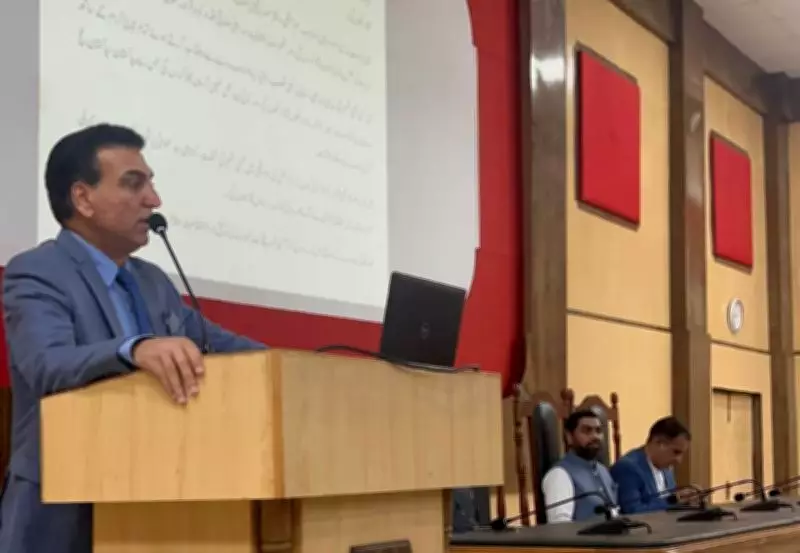
Pakistan Unveils 'Zero-Defect' Hajj Operation with Smart Service Model
Pakistan has officially launched a forward-thinking 'Zero-Defect' operation, marking a significant milestone in the deployment and specialized training of 1,152 Khuddam-ul-Hujjaj. This initiative is driven by a newly introduced Smart Service Model, spearheaded by the Ministry of Religious Affairs and Interfaith Harmony, aiming to revolutionize pilgrimage services with flawless, technology-driven support in the Holy Land.
Strategic Transformation and Role Redefinition
Under this innovative model, welfare staff have been redefined as "Smart Guardians and Guides," equipped with role-specific skills meticulously aligned with their detailed Job Descriptions (JDs). This strategic transformation is designed to ensure a seamless and enriching pilgrimage experience for Dhuyuf-ur-Rahman, the Guests of Allah, by leveraging advanced training and digital tools.
Comprehensive Training Phases
Zulfiqar Khan, the Coordinator for Makkah and Khuddam-ul-Hujjaj, detailed that the training was conducted in two comprehensive phases, following directives from the Federal Minister and Secretary for Religious Affairs. The program commenced with a 10-day general orientation, providing a broad overview of responsibilities and protocols.

This was followed by an intensive three-day specialized training, divided into key operational modules:
- Day 1: Focused on foundational competencies, including building inspections, pilgrim induction procedures, and wheelchair distribution systems. Supervisory staff, known as Nazmeen, received in-depth instruction on the "Mashair Strategy," aimed at facilitating smooth and coordinated movement of pilgrims across Makkah, Mina, and Arafat.
- Day 2: Emphasized logistics and digital integration, with practical exercises covering bus requisitioning, drop-point management, and kitchen supervision protocols. A major highlight was dedicated training on the Digital Complaint Management System (CMS), enabling real-time monitoring and prompt resolution of pilgrim grievances.
- Day 3: Shifted attention to specialized operational tasks, such as lost baggage tracing and service delivery in Madinah Munawwarah. The training concluded with a comprehensive assessment to evaluate participants' understanding and readiness for their critical roles.
Enhanced Accountability and Strict Code of Conduct
To reinforce accountability and operational efficiency, the Ministry has implemented a strict Code of Conduct. Mandatory measures include the use of prescribed uniforms and GPS-enabled tracking systems, ensuring real-time monitoring of staff movement and service delivery. Zulfiqar Khan underscored that serving pilgrims must remain the foremost priority, taking precedence over personal religious activities.
He also announced a zero-tolerance policy for misconduct, warning that any official found involved in corruption, accepting gifts, or neglecting duties would face immediate repatriation, forfeiture of allowances, and permanent disqualification from future Hajj assignments. This robust framework aims to uphold the highest standards of integrity and service excellence.
This 'Zero-Defect' operation represents a pivotal step in Pakistan's commitment to enhancing the Hajj experience through technology, training, and stringent oversight, setting a new benchmark for pilgrimage management.

