Pope Leo XIV Leads Mass for Thousands in Angola, Addressing Poverty and Inequality
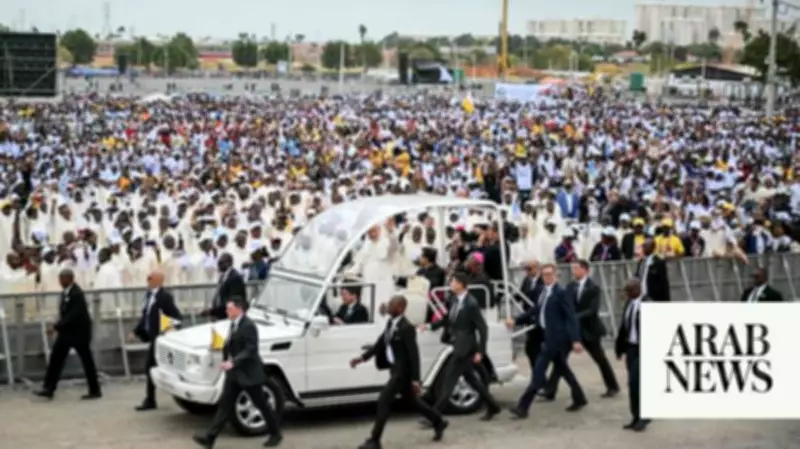
LUANDA: Tens of thousands of faithful gathered on the outskirts of Angola's capital, Luanda, for a massive open-air Sunday mass led by Pope Leo XIV. This event marked the second day of his visit to the resource-rich yet deeply impoverished nation, part of an 11-day apostolic journey across Africa.
The Pope arrived in Portuguese-speaking Angola on Saturday, commencing the third leg of his four-nation African tour. Upon landing, he immediately engaged in discussions with President Joao Lourenco and other officials, where he voiced strong opposition to oppression and the widespread suffering caused by poverty and the rampant exploitation of natural resources.
Messages of Hope Amid Economic Struggles
Multitudes, many seeking a message of hope in challenging times, turned out to join Pope Leo for the mass at Kilamba. Patricio Musanga, a 32-year-old attendee, expressed his desire for encouragement for Angola's youth, who often seek better opportunities abroad due to a lack of local employment.

"He needs to give us hope, to help us understand that from here we can live better than abroad," Musanga told journalists. He highlighted the glaring inequality in Angola, noting, "We are very rich in natural resources but ... there is a glaring inequality between those who live well and the others."
Despite being one of Africa's top crude oil producers and rich in diamonds, approximately one-third of Angola's 36.6 million population lives in poverty, according to World Bank data. Father Pedro Chingandu, who traveled from the eastern province of Moxico for the mass, emphasized the concentration of wealth among a few and the lingering effects of the civil war that ended in 2002.
"We need real democracy and the redistribution of wealth and justice," Chingandu stated, reflecting broader societal concerns.
Historical Pilgrimage and Colonial Legacy
Following the mass at Kilamba, Pope Leo traveled by helicopter to Muxima, Angola's most venerated pilgrimage site. Here, a 300-year-old church overlooks a river that was once a major slave trading route. The church, home to a statue of the Virgin Mary known as "Mama Muxima," attracts around two million pilgrims annually.
Built by Portuguese colonial settlers to baptize slaves before their transport to the Americas, the site holds deep historical significance. The Angolan government has initiated a multi-million-euro project to build a basilica and public services in Muxima, though this has sparked criticism regarding spending priorities amid widespread poverty.
Political Context and International Remarks
Poverty was partly blamed for a three-day looting spree in Luanda and other towns in July last year, resulting in approximately 30 deaths. Analysts suggest this unrest signals dissatisfaction with President Lourenco's socialist MPLA party, which has held power since independence in 1975.
During his flight to Angola, Pope Leo expressed regret that a war of words with US President Donald Trump had overshadowed much of his trip. Trump had labeled the Pope "weak" after he called for an end to the Middle East war. Leo clarified, "It is not in my interest at all to debate the US leader."
From Angola, Pope Leo will proceed to Equatorial Guinea, the final stop of his whirlwind 18,000-kilometer journey across the continent, continuing to advocate for social justice and peace.