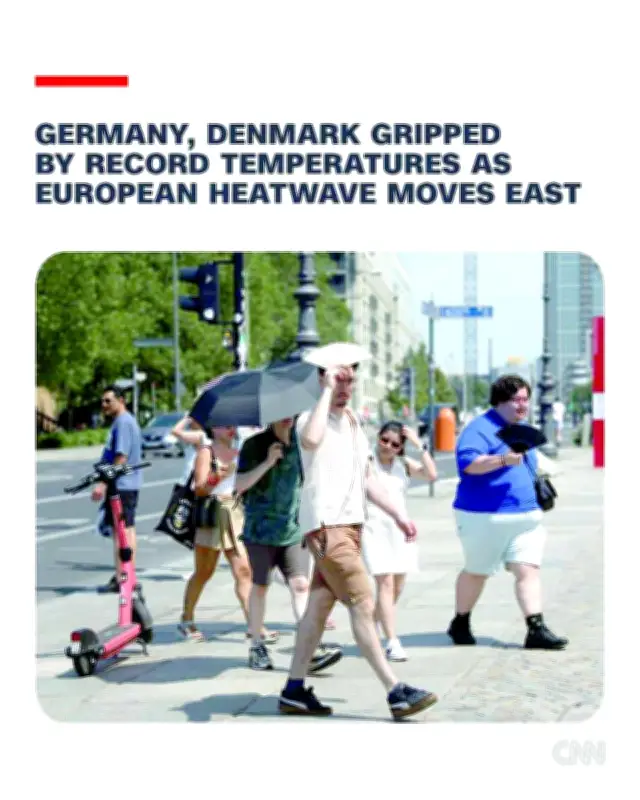
A severe heatwave sweeping across Europe has led to record-breaking temperatures, dozens of deaths, and widespread disruption to infrastructure and daily life. From Scandinavia to the Alps, sweltering conditions on Saturday saw the mercury breach 40 degrees Celsius (104 degrees Fahrenheit) in several locations as the heatwave moved eastward.
Record Temperatures Across Europe
Denmark recorded its highest-ever temperature on Saturday, with the Danish Meteorological Institute reporting 37 degrees Celsius north of the city of Aarhus, the highest since measurements began in 1874. Germany set a new national record on Friday, hitting 41.3 degrees Celsius near Saarbruecken on the French border, according to preliminary data from Germany's National Meteorological Service. These records follow extreme heat in Britain, France, Switzerland, and Germany in June, with the heat system now rolling toward Poland.
Karsten Brandt, a meteorologist at Donnerwetter.de, stated: "The heatwave is going to peak at the weekend at well over 40 C in some parts of Germany." Temperatures across Germany were expected to average 36 degrees Celsius, with local highs up to 42 degrees Celsius possible. Poland also saw temperatures rise well above 30 degrees Celsius across nearly all of the country.

Climate Change Attribution
Scientists have linked the extreme heat to man-made climate change, noting that the current night-time temperatures are 100 times more likely than they would have been two decades ago. The heatwave would have been virtually impossible without human-induced global warming, according to researchers.
Impact on France: Deaths and Disruptions
In France, dozens of people—both young and old—have died during the heatwave. Temperatures above 40 degrees Celsius have disrupted rail travel and power generation, sparked alcohol bans, suspended schools, and postponed outdoor events. The French prime minister's office warned that although the heatwave is moving on, pressure on the healthcare system would persist, and hospitalizations would remain high for several days. Officials also reported an increase in wildfires compared to the same period last year due to the heatwave.
Italy's Red Alert and Night-Time Records
Italy's health ministry issued a red alert for 18 cities, including Milan, Rome, Turin, Venice, Genoa, Florence, and Bologna, for Saturday and Sunday, with temperatures expected to climb as high as 39 degrees Celsius. In Bolzano, in the Italian Alps, Friday marked the warmest June night on record, with overnight temperatures not dipping below 25.4 degrees Celsius, according to city meteorologist Dieter Peterlin on X.
Infrastructure Strain and Travel Disruptions
Rail providers across Europe have taken precautions to prevent damage from buckling roads and swelling train tracks. Germany's national rail operator Deutsche Bahn allowed customers to cancel long-distance travel into early next week without charge to ease pressure on its network. National Express suspended some trains on Saturday afternoon in North Rhine-Westphalia, Germany's most populous state, as a precaution. Near Hamburg, the main traffic lane on one of Germany's busiest motorways was partially closed after heat caused the asphalt to split.
Adaptations and Forecast
In Switzerland, the Lausanne Pride march proceeded on Saturday with extra water fountains and first responders, while Milan's Pride march was pushed back to 5 p.m. to avoid the worst heat. The most extreme temperatures are forecast to begin fading over the weekend, with heavy thunderstorms expected on Sunday. Across Europe, cultural landmarks have closed, farming has suffered, and some hospitals have struggled to cope with the heatwave's impacts.