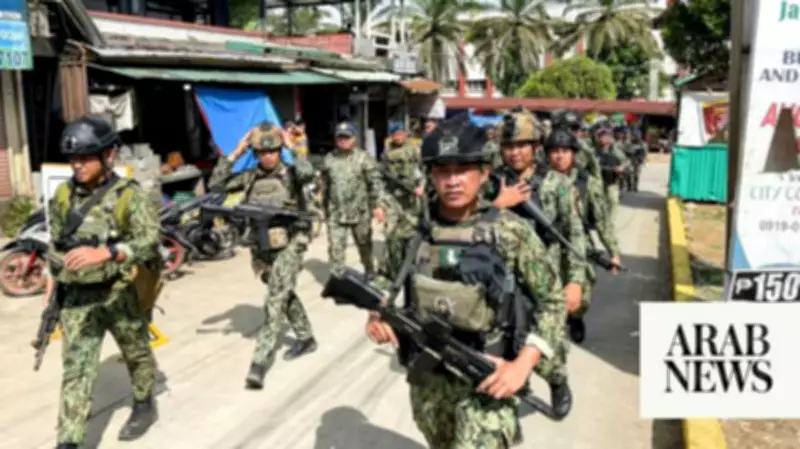
Philippine Army Warns of Militant Resurgence After Deadly Clash in Southern Region
The Philippine military has issued a stark warning about militant groups attempting to stage a comeback in the country's volatile southern provinces, following a deadly security operation that resulted in the deaths of ten suspected Daesh-affiliated fighters. This development underscores ongoing security challenges in a region historically plagued by extremist violence.
Deadly Operation Targets Maute Group Leadership
According to the Western Mindanao Command of the Armed Forces of the Philippines, security forces conducted a targeted operation in Marantao village, Lanao del Sur province, during the early hours of Friday. The engagement resulted in the neutralization of ten members of the Maute Group, also known as Islamic State Lanao—a militant organization with a history of bombings and deadly attacks in the southern Philippines that pledged allegiance to Daesh in 2015.
Among those killed were key leadership figures, including the faction chief Amerol Mangoranca, also known as Usman, and another high-ranking member identified as Muslih. Military officials have linked Mangoranca and his fighters to a January ambush in neighboring Lanao del Norte province that killed four soldiers and wounded another, highlighting their continued operational capacity despite previous setbacks.

Military Warns of Recruitment and Resurgence Efforts
Colonel Roden Orbon, spokesperson for the Western Mindanao Command, told media that the militant groups are actively attempting to reorganize and prove their operational capabilities. "They're trying to be resurgent; they want to prove that they are still capable of organizing," Orbon stated. "They were doing some recruitment. They are trying to do this discreetly because they are aware that our troops are conducting extensive and intensive intelligence operations."
Orbon credited successful intelligence gathering for enabling security forces to pinpoint the militants' location, leading to the recent operation. He emphasized that while the Maute Group has been largely decimated, the Philippine military continues pursuit operations against remaining members and is actively following new leads. The spokesperson estimated that the group likely now comprises fewer than ten individuals, but warned that even small numbers can pose significant security threats.
Historical Context: The Marawi Siege Legacy
The recent clash occurs against the backdrop of the devastating 2017 Marawi siege, one of the longest-lasting battles against militants in the southern Philippines. In that five-month conflict, Philippine security forces launched a massive military operation after Marawi City was overrun by fighters from the Maute group and Daesh, known as the Islamic State—East Asia Province.
The battle resulted in profound human suffering:
- More than 1,100 people killed
- Over 300,000 residents displaced
- Hundreds more wounded
During the Marawi operation, security forces eliminated key militant leaders including Omar Maute and Abdullah Maute, the main leaders of the Maute Group, as well as Isnilon Hapilon, who served as the Islamic State's designated leader in Southeast Asia. Despite these significant losses, remnants of these groups have persisted in the region.
Ongoing Security Challenges and Military Response
The Philippine military maintains that while substantial progress has been made in degrading militant capabilities in the southern provinces, the threat of resurgence remains a persistent concern. Security forces continue to conduct intelligence-driven operations aimed at preventing the reorganization of extremist networks.
The Western Mindanao Command, which has jurisdiction over the country's southern regions, has emphasized its commitment to maintaining pressure on remaining militant elements. Military officials note that the groups operate with increased discretion, aware of ongoing surveillance and intelligence operations, making detection and neutralization increasingly challenging.

This latest operation demonstrates both the continued presence of militant threats in the southern Philippines and the military's ongoing efforts to address security challenges in a region that has experienced decades of conflict. The successful targeting of leadership figures represents a significant blow to reorganization efforts, but military officials caution that vigilance remains essential as small cells continue to seek opportunities for recruitment and operational planning.