WASHINGTON - The United States and Iran have signed a memorandum of understanding to end a near four-month war, senior US officials said on Monday, adding that a formal signing ceremony would take place on Friday and shipping traffic in the Strait of Hormuz would significantly but gradually ramp up.
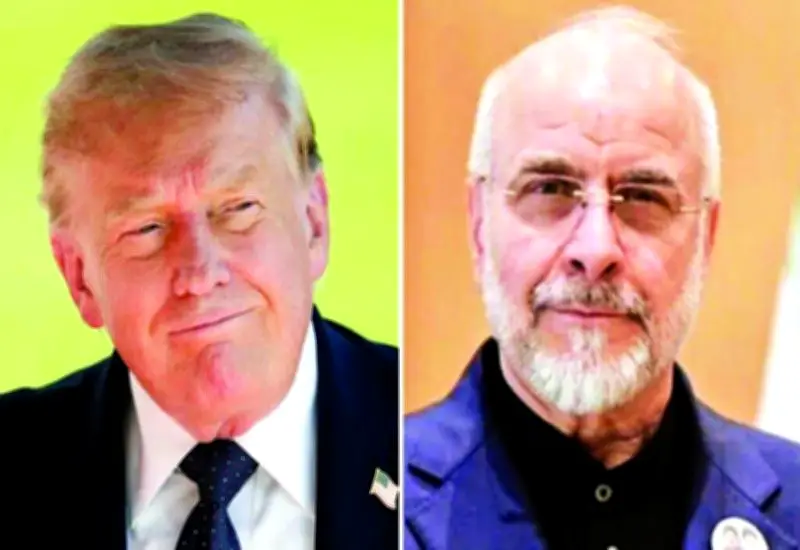
The memorandum of understanding has been signed by President Donald Trump and Vice President JD Vance and Iranian parliament speaker Mohammad Bagher Qalibaf, one U.S. official said.
US President Donald Trump said on Monday a memorandum of understanding aiming to end the war in the Gulf has already been signed by the United States and Iran, drawing calls from his opponents to publish the text.

“The deal’s all signed. And the strait is already partially opened,” Trump said shortly after arriving in France for a summit of the G7 group of big economies, hailing the agreement to open the Strait of Hormuz, where a three-month blockade of Gulf oil supplies has caused global economic disruption.
An official signing ceremony for the agreement is due to be held on Friday in Geneva, just an hour’s drive away along the lakeshore from the summit venue of Evian-les-Bains in the French Alps.
Asked when the text of the memorandum would be made public, Trump said: “Probably pretty soon. I would say after sometime after Friday... I think sometime in the very near future.”
US Senate Democratic leader Chuck Schumer of New York called on Trump to release the details publicly and brief Congress.
“The American people deserve details and full transparency - what exactly is in this ‘understanding’?” Schumer asked in a statement. “Will service members remain in harm’s way. And what have we actually gained here from Trump’s war?”
A US official said Israeli withdrawal from Lebanon was not a condition of the deal: “The deal is a ceasefire, and it will not be a one-way ceasefire, meaning that if Iran is not able to control Hezbollah, and if they attack Israeli positions or Israeli towns, Israel will have the right to defend themselves and respond.” Oil prices tumbled on the prospect of an end to disruption to global energy supplies, and share prices soared, some hitting new records.
According to accounts from both sides, the agreement would reopen the blockaded strait and extend a ceasefire for a 60-day negotiation period, when contentious issues such as the future of Iran’s nuclear programme are due to be decided.
While the terms remain unpublished, US officials say economic benefits to Iran foreseen under the deal are contingent on it satisfying US demands never to build a nuclear weapon.
Vance, speaking to CBS News, said the deal could ultimately end with Iran being given access to a reconstruction fund of up to $300 billion, funded by its Gulf Arab neighbours, provided it fulfills promises to give up nuclear material.
Iranian officials, who have always denied intending to build a nuclear weapon, say they have given up little and have secured Washington’s commitment to lift sanctions, release frozen assets and pay damages for the war Trump launched alongside Israel.
Meanwhile, the immediate fate of the pact could hinge on Lebanon, where Israel has been battling the Iran-aligned Hezbollah armed group in parallel with the wider war that it launched alongside the United States against Iran in February.
Security sources said fighting in southern Lebanon had tamped down on Monday after the agreement was announced but had not ceased entirely.
In the first strike of its kind since the announcement, an Israeli drone struck a car in the southern Lebanese town of Kfar Tebnit, killing the driver, Lebanese state media reported. There was no immediate comment from the Israeli military on the strike.
While the US and Iran had largely ceased hostilities in early April, fighting has not ceased in Lebanon, where Hezbollah opened fire on Israel in support of Tehran on March 2 and Israel responded with an air campaign and ground invasion that has uprooted some 1.2 million people.
Iran’s Foreign Minister Abbas Araqchi said there must be a complete halt to Israeli attacks against Lebanon and wrote on Telegram that the U.S. bears responsibility for implementing the framework deal.

Hezbollah welcomed the deal and said the inclusion of Lebanon reflected Iran’s commitment to securing a halt to the war and preserving Lebanon’s rights.
Israeli Prime Minister Benjamin Netanyahu has yet to respond publicly to the U.S.-Iran agreement. Defence Minister Israel Katz said that Israel would remain “indefinitely” in areas it is occupying in southern Lebanon to eliminate what it perceives as militant threats.
Privately, Israeli officials’ views of the deal have been negative. One senior Israeli official told Reuters on condition of anonymity that the agreement was “terrible for Israel,” and that this assessment was shared throughout the government from Netanyahu on down.
The reopening of the Strait of Hormuz would help solve a global energy crisis precipitated by the war, which has hurt Trump’s political fortunes by forcing up gasoline prices in the United States.
“Ships of the World, start your engines. Let the oil flow!” he wrote on Sunday.
A senior US official who was briefing reporters also talked about the presence of US forces in the Middle East. They said the plan was to keep “the current force posture” during the ongoing negotiations with Iran. “We’ve ramped up a lot of forces in the region to prepare for the operation that started in February. We hope to draw them down, but we’re not doing that yet. We want to see, again, the Iranians do what they promised,” the official said. “The agreement contemplates a reduction of military forces in the region upon the agreement of a final deal, which, again, is the agreement that we assume we can make, so long as the Iranians make some concessions and give us some of their activities and some of their nuclear program.”
A senior US official says the MOUs reached yesterday with Iran will open the Strait of Hormuz “toll-free” over the next 60 days.
However, the official briefing reporters appears to leave open the possibility that tolls by Iran will return after that 60-day period.
“There will be a regional dialogue around what will happen [afterward], but there are no tolls or charges during the time of this MOU,” a second US official says, remaining ambiguous as to what will unfold afterward.
Asked whether sanctions relief will also be tied to Iran’s treatment of its people, a senior US official briefing reporters responds: “Sanctions relief is not tied specifically to any particular conduct; it’s tied generally to [Iran] behaving more appropriately.”
The senior US official says the US cares about how Iran treats its people, but that Iran’s nuclear program and support for proxies are bigger priorities. “We care about the domestic situation too, but I would say that’s the third priority over the first two.”
“We are prepared to release sanctions, and we’ll do some small gestures of that in the beginning, if they make some small gestures to us that show that they’re willing to meet their commitments as well,” a second senior US official on the briefing says.
The senior officials stress that there won’t be any “side deals” made with Iran that will grant it access to frozen funds.
“We discussed the possibility of releasing frozen funds, sanctions relief and a big $300 billion fund to rebuild their country,” the US official says. “All of these things are going to be tied to performance.”
One of the officials insists that Gulf states such as the UAE and Qatar will not ink such side deals with Iran — despite reports to the contrary — because they too want the deal to succeed.