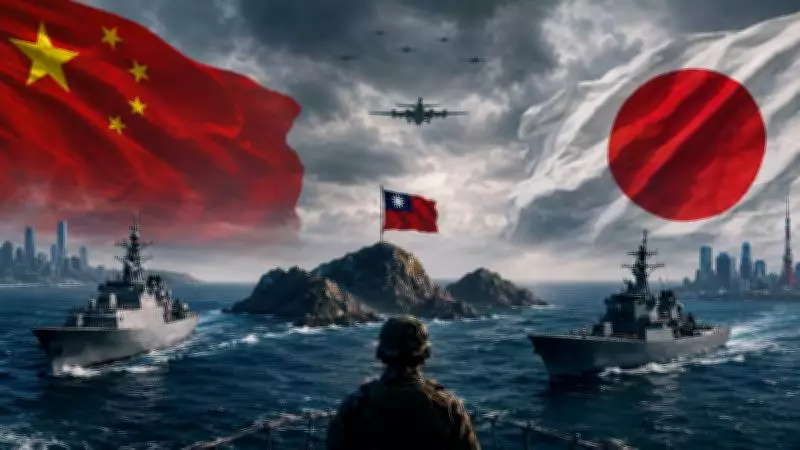
In April 2026, a Chinese defence spokesperson issued an ominous warning: 'Should an evil tiger be unleashed from its cage, it would inevitably wreak havoc far and wide.' The statement was meant as strategic messaging, aimed at Beijing's rivals amid mounting tensions in East Asia. Yet the metaphor unintentionally captured a deeper reality. Across the region, long-standing restraints are eroding. Military buildups are accelerating, economic interdependence is being weaponised, and diplomatic ambiguity is giving way to open strategic confrontation. What is unfolding between China and Japan is no longer a routine territorial dispute or another episode of political friction. It is becoming a stress test for the regional order in Asia, and potentially for the global economy itself.
Japan's Historic Shift on Taiwan
The clearest indication of this shift came on November 7, 2025, when Japanese Prime Minister Sanae Takaichi declared that a Chinese attack on Taiwan would constitute an 'existential crisis' for Japan, giving Tokyo the legal right to respond militarily. For most countries, such a statement might sound ordinary. For Japan, it was historic. Since the end of the Second World War, Japan's national identity has been deeply tied to constitutional pacifism. Article 9 of its constitution renounced war and restricted the maintenance of offensive military forces. For nearly eight decades, this clause shaped Japanese strategic culture, defence policy, and public opinion. Tokyo prioritised economic growth while relying heavily on the United States for security guarantees. But geopolitics has a way of reshaping even the most entrenched national doctrines. Over the years, Japan gradually loosened constitutional interpretations in response to growing regional threats. The 2015 security legislation allowing 'collective self-defence' marked a major turning point, enabling Japan to assist allies under attack. Takaichi's remarks on Taiwan extended that logic further than ever before.
China's Economic Coercion
China's response did not initially come through missiles or military escalation. Instead, it came through economics, increasingly one of Beijing's most powerful geopolitical tools. On January 6, 2026, China announced restrictions on the export of so-called 'dual-use' goods to Japan, materials and technologies with both civilian and military applications. Though framed in technical language, the move carried serious strategic implications. At the centre of the pressure campaign were rare earth elements, critical resources used in electric vehicles, wind turbines, semiconductors, smartphones, and advanced weapons systems. Japan remains heavily dependent on Chinese rare earth supplies. Even temporary restrictions threaten to disrupt key industries, particularly automobile manufacturing and electronics. Economic estimates suggest that a three-month disruption could cost Japan approximately 660 billion yen, while a year-long squeeze could inflict losses exceeding 2.6 trillion yen. For Japanese policymakers and corporations, the move revived memories of 2010, when China informally restricted rare earth exports during an earlier dispute over the Senkaku Islands. The message then was unmistakable, and it remains so today: in the twenty-first century, supply chains can be weaponised as effectively as armies.

The Senkaku Islands Flashpoint
Yet economics is only one layer of a much broader confrontation. Far from the headlines, another flashpoint continues to simmer in the East China Sea: the Senkaku Islands, known in China as the Diaoyu Islands. Though uninhabited, the islands occupy strategically valuable waters near key shipping lanes and potential energy reserves. More importantly, they have become symbols of sovereignty, nationalism, and regional influence. China has steadily intensified its coast guard presence around the islands, maintaining record numbers of patrol days in surrounding waters. Analysts increasingly describe these operations as 'grey-zone tactics'—coercive actions designed to alter strategic realities without triggering outright war. Such tactics thrive in ambiguity. They pressure adversaries continuously while avoiding the kind of escalation that would justify a full military response.

Converging Geopolitical Fault Lines
The danger lies not in any single dispute, but in how all these tensions are beginning to converge. Taiwan, the Senkaku Islands, military modernisation, economic coercion, and U.S.–China strategic rivalry are no longer isolated issues. They are merging into a single geopolitical fault line stretching across East Asia. For Japan, Taiwan is not merely a distant democratic partner. It is a strategic buffer located near Japan's south-western islands and astride critical maritime trade routes. Any conflict in the Taiwan Strait would threaten energy supplies, disrupt shipping lanes, and potentially expose Japanese territory to direct military risk. The implications would extend far beyond Asia. Taiwan's semiconductor industry sits at the centre of the global digital economy. A conflict involving China, Japan, Taiwan, and the United States would send shockwaves through supply chains worldwide, affecting everything from consumer electronics and telecommunications to automobiles and industrial manufacturing. The COVID-19 pandemic has already exposed the fragility of global supply chains. A crisis in the Taiwan Strait would reveal vulnerabilities on an even larger and more dangerous scale.
Military Buildups and Strategic Risks
What makes the current moment particularly alarming is that neither Beijing nor Tokyo appears to seek outright war, yet both are steadily preparing for the possibility of one. Japan is undergoing its most significant military transformation in decades. In late 2025, Tokyo approved a record defence budget of roughly 9.04 trillion yen for fiscal year 2026, representing a 9.4 per cent increase in a single year. The country is moving towards spending nearly 2 per cent of its GDP on defence, a benchmark historically associated more with NATO members than postwar Japan. Quietly but unmistakably, Japan is shedding many of the strategic restraints that defined its postwar identity and re-emerging as a major military power. China, meanwhile, continues expanding both its military capabilities and economic leverage. For Beijing, Taiwan is not simply a territorial dispute; it is tied directly to national rejuvenation, political legitimacy, and the image of Chinese strength under the Communist Party. Any foreign involvement in the Taiwan issue is viewed not merely as strategic competition, but as interference in what China considers a core national interest.
The Danger of Accidental Escalation
This combination—rising nationalism, military expansion, economic coercion, and geographic proximity—creates an environment where even small incidents carry enormous risks. A collision between coast guard vessels near disputed waters. A misinterpreted radar lock. A military exercise near Taiwan spiralling unexpectedly. History repeatedly shows that major conflicts are often triggered not by deliberate decisions alone, but by accidents and miscalculations inside tense strategic environments. The most likely short-term scenario is not immediate war, but sustained confrontation below the threshold of open conflict: more naval patrols, more military drills, tighter economic restrictions, and increasingly confrontational rhetoric.
Conclusion: A Warning for Global Politics
Prolonged grey-zone competition carries dangers of its own. It normalises escalation while steadily narrowing diplomatic space. For decades, East Asia's stability rested on a delicate balance: deep economic integration alongside relative military restraint. That balance is now eroding. The world should pay attention. What is unfolding between China and Japan is not simply a regional rivalry. It is a warning about the future of global politics itself: a world where supply chains become strategic weapons, deterrence replaces trust, and peace survives only through constant tension. And once such a system hardens into permanence, even a single spark can become impossible to contain.