Pakistan's increasing use of cross-border airstrikes inside Afghanistan signals a shift toward a routine military response to militant attacks, political and security analysts said on Monday, maintaining that dialogue was the only way to change the Afghan Taliban’s stance and curb militancy in Pakistan.
Recent Strikes Mark a Pattern
Islamabad conducted overnight strikes in Afghanistan on Monday that marked Pakistan’s fourth such known cross-border operation in 2026 and the sixth since 2022. The escalation followed a Saturday night assault on a paramilitary camp in the southern port city of Karachi. The strikes highlighted how retaliatory military action is becoming institutionalized as ties between the neighbors remain fractured because of a surge in militant attacks in Pakistan’s western regions bordering Afghanistan in recent years.
Analysts See No Positive Outcomes
“Pakistan’s resort to airstrikes inside Afghanistan in response to major militant attacks has increasingly become a new norm,” Abdul Sayed, a Sweden-based Afghanistan-Pakistan security analyst, told Arab News. “However, these operations have not produced any positive outcomes. Instead, they have contributed to escalating tensions between the two countries, ultimately benefiting the very militant groups that Pakistan seeks to target through such strikes.”

Sayed recalled Pakistan conducted its first airstrikes inside the Taliban-ruled Afghanistan in April 2022, saying the intensity of these operations has significantly increased in 2026. “For the first time in history, the Afghan capital, Kabul, became the target of Pakistani aerial bombardment,” Syed said of the Pakistani airstrikes in March this year that Islamabad said had targeted at least 41 militant infrastructure locations inside Afghanistan, including in the capital.
Details of the Latest Strikes
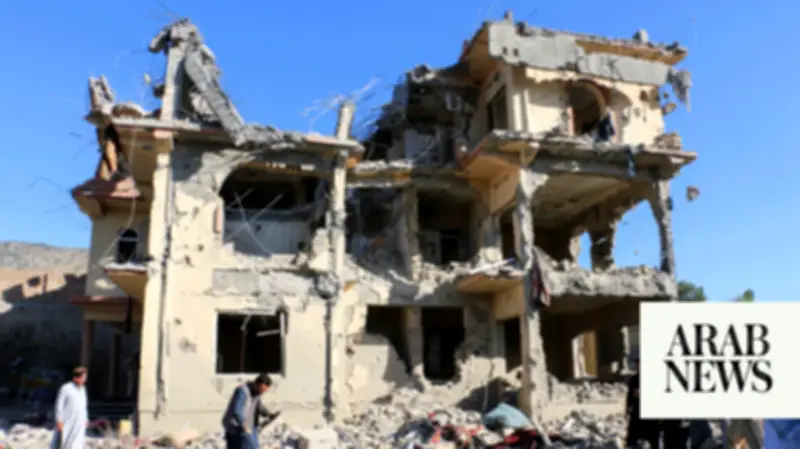
The Pakistani military said Saturday’s precision strikes targeted hideouts of the Jamaat-ul-Ahrar (JuA) and the Tehreek-e-Taliban Pakistan (TTP), which Islamabad describes as Fitna Al-Khawarij, in Afghanistan’s eastern Paktia, Paktika, and Kunar provinces, killing 25 militants. Afghan Taliban authorities said the strikes hit residential areas, killing 36 civilians, majority of them women and children.
Diplomatic Fallout
Pakistan’s Foreign Office on Monday summoned the Afghan chargé d’affaires in Islamabad and issued a demarche over the Karachi attack. Foreign Office spokesman Tahir Andrabi stated that an injured militant captured alive during the Karachi attack was an Afghan national, which he said proved “yet again that Afghan soil and Afghan nationals continue to be used to orchestrate terrorist attacks inside Pakistan.” According to Pakistani security sources, the captured suspect, identified as Usman Ali, confessed to traveling from Jalalabad, Afghanistan, alongside three other attackers. Ali reportedly told Pakistani investigators that they were trained in Afghanistan by a commander, named Qari Umar, received suicide jackets there, and had their logistics managed from the Afghan territory before arriving in Karachi via Waziristan, a northwestern Pakistani region that borders Afghanistan.
Kabul Rejects Allegations
Kabul has repeatedly rejected Pakistan’s claims of supporting cross-border militancy, urging Islamabad to resolve its internal security issues. Analysts noted that “non-kinetic levers,” including border closures, trade suspensions, visa restrictions, and mass refugee repatriations, adopted by Islamabad in recent years have failed to compel the Taliban administration to sever ties with the TTP.
Anger Behind the Strikes
“These strikes are reflective of the anger that Pakistan has about the Afghan Taliban’s attitude, non-compromising attitude, toward controlling the TTP,” said Asif Durrani, Pakistan’s former special envoy to Afghanistan. “Therefore, this TTP has become a one-point agenda between Pakistan and Afghanistan from Pakistan’s perspective.”

Kinetic Action Not Working
Despite the military pressure, experts argue that kinetic action is failing to degrade the TTP’s operational reach inside Pakistan. “If Pakistan’s attacks become regular, normal, becoming a new normal, it does not mean that Pakistan has achieved its targets,” said Sami Yousafzai, an Afghan journalist and political analyst. “Nor has it resulted in any changes or softening in the behavior of the Afghan Taliban.” Yousafzai warned that civilian casualties from the strikes are generating severe anti-Pakistan sentiment inside Afghanistan, inadvertently shielding the Taliban from domestic criticism over internal policies. “The momentum that was building against the Taliban, that they are against women and that their government is entirely unacceptable, has now been diverted to another issue,” Yousafzai said. “In my opinion, for both countries, an alternative policy, this is the only option, is to hold talks.”
Mediation Efforts Stalled
Regional mediators, including China, Russia, Qatar and Turkiye, have previously attempted to facilitate negotiations between Islamabad and Kabul. However, analysts say multiple rounds of talks have broken down completely into a “logjam.” “The right thing, and the viable thing, and the wise thing would be to, to engage in talks, and then you can combine talks with some use of force, some kind of using force as a deterrent rather than a problem solver,” Pakistani journalist and political analyst Nasim Zehra told Arab News. “But as we know, three rounds of talks between Afghanistan and Pakistan, whether it is through the Chinese good offices, whether it’s Turkiye, or whether it is Qatar, we have run into a logjam basically, a deadlock.” Zehra believed the use of force alone would not resolve the issue. “This is the policy of last resort, given that nothing seems to come out of the dialogue, although I think that ultimately it will have to be dialogue,” she added.