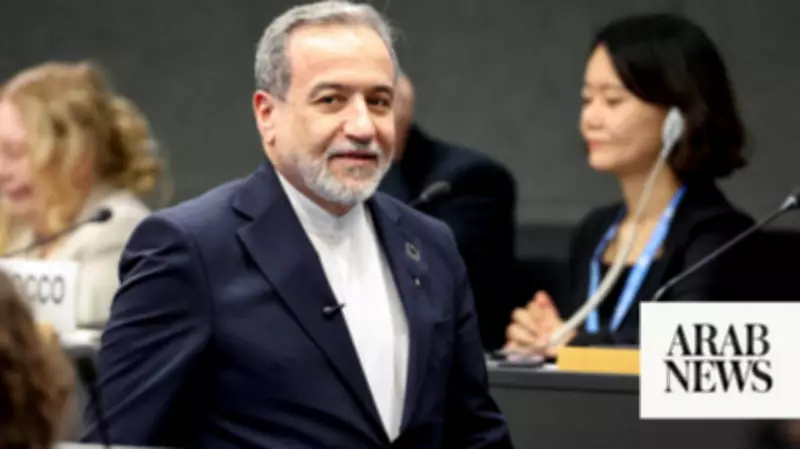
Iran’s Foreign Minister Seyed Abbas Araghchi on Monday blamed the United States for the failure of the first round of peace talks between the two sides, describing his recent visit to Pakistan’s capital as “very positive.” He said he reviewed discussions and held consultations with Islamabad to resume negotiations with Washington.
Peace Talks Stalled
The first round of peace talks between the US and Iran were held in Islamabad on April 11. The talks failed to result in a peace deal, with US Vice President JD Vance stating that Iran had not chosen to accept Washington’s terms. Vance had said the US seeks a “fundamental commitment” from Tehran not to develop nuclear weapons.
Araghchi spoke to the press upon arriving in Moscow, where he is scheduled to meet Russian President Vladimir Putin. The Iranian minister shuttled between mediators Pakistan and Oman on Sunday before flying to Moscow.

“The US approaches caused the previous round of negotiations, despite progress, to fail to reach its goals because of the excessive demands and incorrect policies,” Araghchi told a reporter after arriving in Moscow.
He said it was necessary to hold consultations with Pakistan to review the latest situation in the region. “Thank god, the visit was very positive, and we reviewed what had transpired and the conditions under which the negotiations could continue,” the Iranian foreign minister said.
US Stance
A day earlier, President Donald Trump told Fox News that if Iran wanted to speak to the US, “they can come to us or they can call us.” “They know what has to be in the agreement. It’s very simple: They cannot have a nuclear weapon, otherwise there’s no reason to meet,” the American president said.
Iran has long demanded Washington acknowledge its right to enrich uranium, which Tehran says it only seeks for peaceful purposes, but which Western powers say is aimed at building nuclear weapons.
Conflict Background
Although a ceasefire has paused full-scale fighting in the conflict, which began with US-Israeli strikes on Iran on February 28, no agreement has been reached on terms to end a war that has killed thousands, driven up oil prices, fueled inflation, and darkened the outlook for global growth.
Pakistan has positioned itself as a key mediator during the US-Iran conflict, brokering a ceasefire between Washington and Tehran which was extended by Trump last week at Islamabad’s request. Pakistan hopes it can broker peace between the two sides, with surging global oil prices and resulting inflation adversely affecting the South Asian country’s fragile economy.