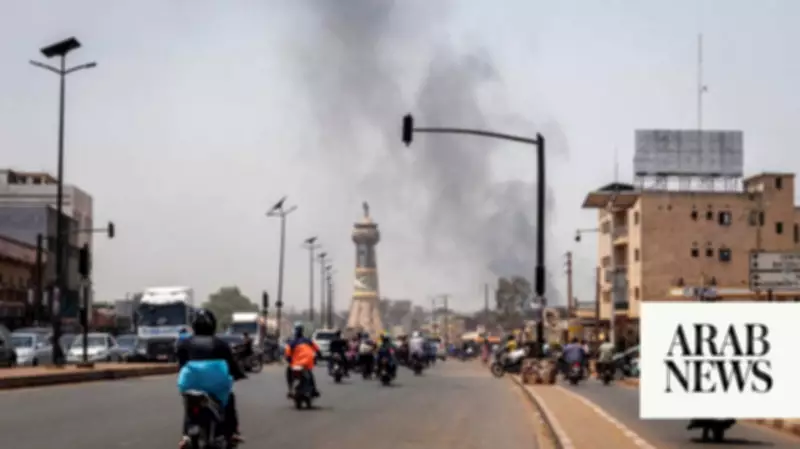
Mali's military rulers faced a deepening crisis on Sunday after coordinated nationwide attacks by jihadist fighters and separatist rebels killed the defense minister and led to the reported capture of the strategic northern town of Kidal. The synchronized offensive, carried out by Tuareg separatists of the Azawad Liberation Front (FLA) alongside the Al-Qaeda-linked Group for the Support of Islam and Muslims (JNIM), marks an unprecedented alliance between the two groups and the most serious challenge to Mali's junta since it seized power.
Defense Minister Killed in Car Bomb Attack
Defense Minister Sadio Camara was killed on Saturday when a car bomb struck his home in Kati, a military stronghold near the capital Bamako. His family said his second wife and two grandchildren also died in the blast. Authorities stated that Camara fought back against the attackers before succumbing to his injuries in hospital. There was no immediate public appearance by junta leader General Assimi Goita following the attacks, though security sources confirmed he was in a safe location. Fighting continued across multiple locations, including Kati, the central town of Sevare, and the northern cities of Gao and Kidal, underscoring the scale and coordination of the assault.
Kidal Declared 'Free' as Forces Withdraw
Separatist leaders declared Kidal, a longtime rebel bastion, as free, stating that Malian forces and Russian Africa Corps troops had withdrawn following an agreement allowing their peaceful exit. FLA spokesperson Mohamed El Maouloud Ramadan said, 'Kidal is declared free.' Residents reported seeing military convoys leaving the city as rebel fighters took control of the streets. Mali's army did not confirm a withdrawal, only stating that it was 'tracking down terrorist armed groups' in the area. Kidal had been recaptured by government forces in November 2023 with the help of Russian mercenaries from the Wagner group, which was then hailed as a major symbolic victory for the junta. Its apparent loss now represents a significant reversal. The FLA also said it had seized positions in parts of the Gao region, suggesting the offensive has extended across northern Mali.

First Joint Offensive with Jihadists
Saturday's wave of attacks was notable for the formal coordination between separatist and jihadist groups, a first in Mali's long-running conflict. Ramadan said, 'This operation is being carried out in partnership with the JNIM,' adding that both groups were acting against what they described as a repressive military regime in Bamako. Security analysts said the scale, simultaneity, and political messaging of the attacks marked a turning point. Wassim Nasr of the Soufan Center noted, 'This coordination, conducting attacks all over the country at the same time… is a first,' highlighting that the alliance extended beyond tactical cooperation into open political alignment. JNIM said it had also targeted areas near Bamako and at least three other cities, widening the conflict's geographic scope.
Capital on Edge, Curfew Imposed
In Bamako, troops erected roadblocks around key installations as residents reported explosions and gunfire. The government imposed a three-day overnight curfew across the capital district. One resident said, 'I still hear the blasts ringing in my ears. It's traumatizing.' Authorities reported at least 16 people, including civilians and military personnel, were wounded, while several militants were killed. No overall death toll has been released. Despite the violence, the international airport, just outside Bamako, resumed operations on Sunday after temporary disruption.
Regional and Global Alarm
The offensive has drawn swift international concern. UN Secretary-General Antonio Guterres condemned the violence and called for coordinated global support to combat extremism in the Sahel. The European Union also denounced the attacks as terrorism. The Economic Community of West African States urged regional governments and security forces to unite against the escalating threat. The Alliance of Sahel States, comprising Mali, Burkina Faso, and Niger, described the attacks as a 'monstrous plot' backed by external enemies.

Russia's Role Under Scrutiny
The crisis also raises questions about the effectiveness of Mali's pivot toward Russia after severing ties with France and other Western partners. Russian forces, now operating under the Africa Corps following the reorganization of the Wagner group, have been central to the junta's counterinsurgency strategy. However, analysts say the latest attacks expose serious intelligence and security gaps. Ulf Laessing of the Konrad Adenauer Foundation stated, 'The attacks are a major blow to Russia… they were unable to protect major cities.' Separatist leaders have openly called on Moscow to reconsider its support for Mali's military rulers, accusing Russian-backed operations of worsening civilian suffering.
A Widening Conflict
Mali has endured more than a decade of insurgency and instability, but the latest developments signal a dangerous new phase. The rare alignment between separatists seeking independence for northern Azawad and jihadists linked to Al-Qaeda suggests a convergence of interests that could further destabilize the region. Although experts say the insurgents are unlikely to capture Bamako in the near term, the coordinated assault has shaken confidence in the junta's ability to deliver on its promise of security. Opposition groups warned the country was 'in danger,' stating that recent events showed Mali was neither stable nor secure. With fighting ongoing, a key city apparently lost, and alliances shifting on the battlefield, Mali's leadership now faces its most severe crisis in years, one that could reshape the balance of power across the Sahel.