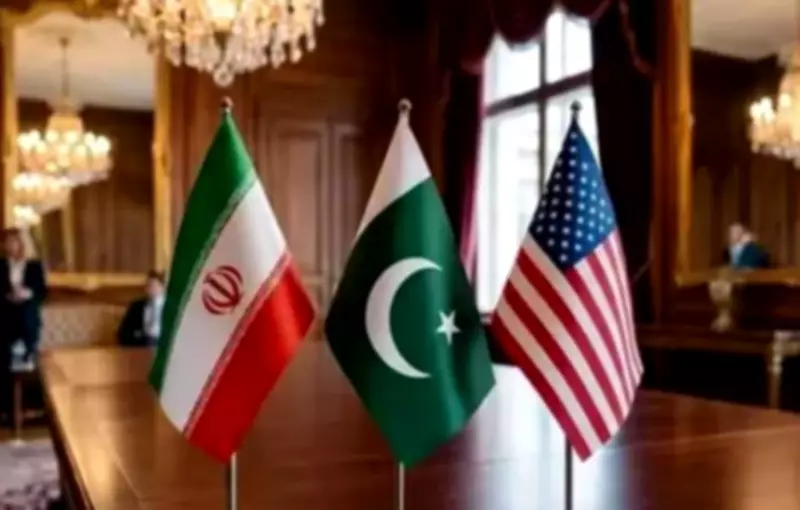
ISLAMABAD - Pakistan on Thursday expressed optimism regarding a possible agreement between Iran and the United States, anticipating a resolution "sooner rather than later." During a weekly news briefing, Foreign Office spokesperson Tahir Andrabi stated that Pakistan remains hopeful that ongoing diplomatic efforts will culminate in a peaceful settlement.
"We expect an agreement sooner rather than later," he said, while refraining from disclosing specifics of the negotiations. He emphasized that Pakistan, acting as a facilitator, would uphold the trust of all parties involved. "It is incumbent on us to uphold the trust of respective positions. We will jealously guard any information that we have, particularly with respect to the specifics," he remarked.
When asked whether Islamabad would host a potential signing ceremony between Tehran and Washington, Andrabi said Pakistan would welcome any peaceful settlement regardless of the venue, though hosting such an event in Islamabad would be "an honor and a privilege." He also welcomed the reported pause in US military operations around the Strait of Hormuz, stating that Pakistan supports all measures leading toward de-escalation and peaceful settlement.

Relations with Afghanistan
On relations with Afghanistan, the spokesperson noted that recent local ceasefire agreements between tribal elders on both sides of the border reflect the peoples' desire for peace. However, he maintained that terrorism emanating from Afghan soil remains the central obstacle preventing normalization of ties. "The people of Pakistan and Afghanistan have no major dispute," he said. "But this one-point issue of terrorism affecting Pakistan, emanating from Afghan soil, is holding back our relations."
Andrabi urged the Taliban administration in Kabul to demonstrate "zero tolerance" for terrorist groups operating from Afghan territory against Pakistan. He stated that issues such as border closures, trade restrictions, and visa suspensions could be resolved once credible assurances are provided that Afghan soil will not be used for attacks against Pakistan.
Commitment to Diplomacy and National Sovereignty
The spokesperson underlined Islamabad's commitment to diplomacy, regional peace, and national sovereignty. Regarding the first anniversary of "Marka-e-Haq," he said the occasion reinforces Pakistan's national resolve to defend its sovereignty, territorial integrity, and political independence "with all means possible and with full determination."
Responding to concerns expressed by diplomats over regional peace and hostile rhetoric from India, Andrabi said the interaction between Deputy Prime Minister and Foreign Minister Ishaq Dar and the diplomatic corps had taken place in-camera, therefore details could not be shared publicly. However, he noted that peace and security in South Asia remain a major concern for the international community. "The belligerent statements emanating from New Delhi are a cause of concern," he added, noting that Pakistan's advocacy for dialogue and diplomacy continues to receive appreciation from international partners.
No Confrontation, But Full Response to Aggression
The spokesperson emphasized that Pakistan does not seek confrontation but will decisively respond if aggression is imposed. "We do not talk of war. We talk of dialogue and diplomacy. However, if an aggression, which took place exactly a year ago, is imposed on us, Pakistan will respond, and will respond with full strength and all means available," he said.
Addressing reports suggesting another Pakistan-India clash is inevitable, Andrabi stated that Pakistan's positions on all bilateral disputes with India are firmly anchored in international law, the UN Charter, and relevant UN Security Council resolutions. He said Pakistan remains ready for meaningful dialogue with India and has "never shied away" from negotiations, but stressed that dialogue requires willingness from both sides. "Even a dialogue has to be meaningful; it has to be a dialogue and not a monologue," he remarked.

Military Modernization and Water Rights
On India's growing military acquisitions, including advanced aircraft and missile defence systems, the spokesperson said Pakistan is closely monitoring developments and will maintain its "credible minimum deterrence." "We are mindful of the impact of India's force modernization on strategic stability in South Asia," he assured, adding that Pakistan's military preparedness and defence acquisitions will remain sufficient to ensure robust national defence capabilities.
Turning to the Indus Waters Treaty, Andrabi said Pakistan reserves the right to pursue all legal, political, and diplomatic mechanisms available under international law and the treaty framework to protect its water rights. "All options remain on the table," he said, adding that Pakistan is comprehensively documenting river flows, water patterns, and any potential violations linked to the treaty's implementation. He stated that all relevant institutions, including the Indus Water Commissioners, remain fully focused on ensuring Pakistan's rightful share of water. "Not a drop of water is stolen from Pakistan from what is our right," he asserted.
Terrorism in Balochistan and Other Issues
Discussing terrorism in Balochistan, the spokesperson paid tribute to security personnel and civilians martyred in militant attacks and said Pakistan is pursuing a comprehensive strategy involving both security operations and diplomatic engagement. He said Pakistan is presenting evidence regarding external support for terrorist groups at international and UN counterterrorism forums. "The effort to curb terrorism in Balochistan is comprehensive from the law enforcement perspective as well as from the diplomatic perspective," he said.
Regarding Indian national Kulbhushan Jadhav's case, Andrabi said the matter remains under legal process and "the law will take its course." The spokesperson also rejected suggestions that Pakistan interferes in India's domestic politics, describing elections in Indian states as New Delhi's internal matter.
On reports that India has urged several countries not to provide defence technologies to Pakistan, Andrabi said such démarches reflect "paranoia" in New Delhi and will not affect Pakistan's longstanding defence partnerships. "No diplomatic move by India can offset these relations, which have a trajectory and an institutional strength of their own," he said.
Deportations from UAE
Responding to queries about deportations of Pakistanis from the UAE, Andrabi said Pakistani diplomatic missions in Abu Dhabi and Dubai are actively handling consular matters. He disclosed that between January and April 2026, Pakistan's Consulate General in Dubai issued around 2,714 Emergency Travel Documents while the embassy in Abu Dhabi issued 780 such documents. He said many deportations are linked to immigration violations and legal infractions, while some cases emerged following royal pardons granted during Eid that facilitated the release and repatriation of jailed individuals. "Our missions are in touch with UAE authorities," he added, noting there is no indication of any politically motivated expulsions.
The spokesperson clarified that Pakistan's recently announced transit routes for Iran are linked to the operationalization of a long-standing bilateral agreement.