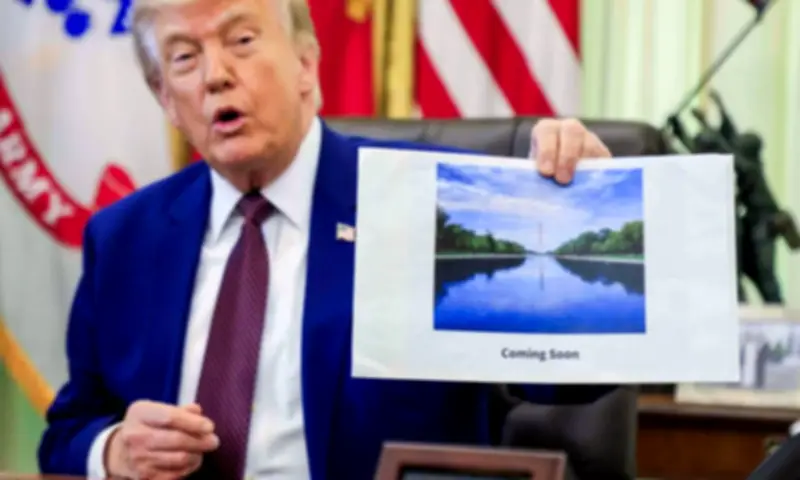
President Donald Trump launched an expensive beautification effort for the Reflecting Pool, repainting the bottom and using chemical treatments to address algae, only to cause a new algae bloom likely due to the paint color. He bypassed federal contracting procedures to award a no-bid contract to a personal acquaintance who had previously pleaded guilty to conspiracy to bribe a politician. After the renovation failed, Trump made unsubstantiated accusations of sabotage and announced the arrest of six people on vandalism charges, including former US Olympian David Hearn, who claimed he merely touched material in the pool. Trump has threatened alleged vandals with 10-year prison sentences.
Deeper Dysfunction
This saga reflects broader dysfunctions in the Trump administration, from ignoring experts to scapegoating failures. It illustrates a core dynamic: Trump is authoritarian at heart but inept at authoritarianism, often distracted by small symbolic issues that escalate into proxy wars over his ego. If American democracy remains resilient, these time-consuming distractions will be a key factor.
Trump's Obsession with Appearances
Trump has always prioritized symbolic issues, as seen on his first day in office when he insisted on the largest inauguration crowd ever, forcing press secretary Sean Spicer to lie. In his second term, this fixation has turned into a preoccupation with physically altering the White House and Washington, DC. Examples include demolishing the White House East Wing to build a 90,000-square-foot ballroom, covering the Oval Office in gold, building a UFC octagon on the White House lawn, appointing himself chair of the Kennedy Center board to rename it after himself, commissioning a 250-foot arch across the Potomac, and spearheading a federal takeover of DC's public golf courses.

Unlike previous presidents who renovated for functional reasons—such as Harry Truman fixing a structurally unsound residence—Trump's efforts bypass normal processes and exercise personal control. The Reflecting Pool kerfuffle is not a deviation but a core part of his agenda: deep personal investment in altering his physical surroundings.
Strategic Misuse of Attention
White House attention is a finite resource, and Trump's obsession with physical alterations is not a strategic use of presidential time. In the Reflecting Pool case alone, he wasted millions in taxpayer money, gave a no-bid contract to a confessed criminal, and threatened Americans with jail time. These efforts often get entangled in bureaucratic and legal struggles, leading Trump to spend extensive time on Truth Social or with reporters, forcing his PR and legal teams to manage consequences.
Trump's focus on image over substance, rooted in his reality TV background, is devastating for a presidency with grand ambitions. His disdain for checks on power leads him to act as an elected dictator, wielding political power against enemies. Advisers like Russ Vought, Stephen Miller, and JD Vance have harnessed this style to break elements of the US government, such as congressional control over the purse. However, they have failed to pair this damage with substantive consolidation of power. Trump's policies face legal problems, efforts to jail enemies flounder, and attempts to suborn elections—including gerrymandering and centralizing vote-counting—have not prevented a looming Democratic midterm wave.
Haphazard Authoritarianism
Trump's approach to authoritarianism is haphazard, driven by impulse rather than strategic planning, unlike Viktor Orban's methodical power seizure in Hungary. This prioritizes imagery over sustained policy follow-through, weakening his ability to wield power. His approval ratings scrape new lows due to perceptions that his focus is on personal priorities over issues like inflation and healthcare. The attentional dynamics reflect a president too undisciplined to make good on his promises. The obsession with meaningless symbolism like the Reflecting Pool may prove a key element in his administration's looming failure.