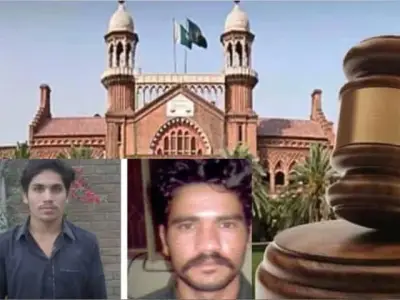
Before he threw the acid, he knocked. That detail lingers. The CCTV footage from Civil Sandeman Hospital in Quetta shows a man at a door, knocking, waiting. A lift operator named Humayun Shah. On the other side, Dr. Mahnoor Nasir, a postgraduate trainee in general surgery, was ending a duty shift like any other day. She opened the door because that is what you do when someone knocks. Then he poured acid on her face, her abdomen, her thighs and her hand, and he ran.
She is at Aga Khan in Karachi now, flown there by air ambulance. Stable. Her eyesight, the doctors say, is intact, which in a story like this passes for mercy. The man is dead, killed in a police 'encounter' near Nushki before anyone could ask him a single question inside a courtroom. On his phone, investigators found months of messages. He had wanted her. She had said no. So that is where we should begin. Not with the acid. With the no.
The Wrong Words
We keep reaching for the wrong words when this happens. Tragedy. Senseless. There is no sense in it. Acid is not a crime of passion, whatever that phrase is meant to soften. It is cheap, slow to plan, and chosen for a reason. In the cotton districts of South Punjab, where the Acid Survivors Foundation says more than half of Pakistan's acid crimes occur, you can buy a litre for less than a plate of biryani because it is used to clean cotton.

Nobody picks up a bottle of acid to end a life. A bullet does that faster. Acid is picked up to mark a life. To take the face and leave the person inside it. To guarantee that, if he cannot have her, no one will look at her the same way again. That is the whole logic, and it is not new.
Stories of Survivors
Zainab Bibi, seventeen, once slapped a neighbour who would not stop harassing her. Three nights later, he climbed the wall while she slept and emptied acid over her, then swore on the Quran in front of a tribal panchayat that he had touched nobody. His reasoning, when it surfaced, fit into one sentence: if he could not marry her, no one else should.
Masarrat Misbah, who has run the Smile Again Foundation for decades and registered hundreds of survivors, has heard the reasons until they blur together: a marriage proposal refused, a daughter born where a son was wanted, a dowry that came up short. None of these is an accident of temper. They are sentences passed down by men who decided, somewhere along the way, that a woman's body was theirs to ruin.
The Root of the Problem
Here is the part we are worst at admitting. The man with the bottle is not a stranger to our society. He is its most obedient student. He learns it early, long before he can spell honour. He learns that a woman in his orbit, a sister, a daughter, the doctor down the hospital corridor he had quietly filed under 'mine', is not really a separate person with her own future. She is an extension of his standing. Her choices reflect on him. Her refusal humiliates him. Until we are willing to raise boys who can hear the word 'no' and walk away, we will keep doing this.
Researchers who study gender-based violence in Pakistan keep returning to the same root: family honour gets located in the bodies of women, so men feel entitled to police those bodies, and a woman who decides her own marriage, her own clothes, her own answer, is read as a theft of something that belonged to a man. Clinicians describe the psychology in plainer terms: rejection sensitivity, a need for control that curdles into rage the moment it is denied. The inability to hear 'no' as anything other than an insult requiring an answer. And the answer is designed to last. A bruise heals. A broken bone sets. Acid is forever, and that permanence is the point.
He is not trying to win an argument. He is trying to write his ownership onto her skin so that she carries it for the rest of her life, in every mirror, every staring queue at the bazaar, every introduction where someone's eyes flick away. That is what entitlement looks like when it loses. It would rather destroy the thing than let the thing be free.

The Numbers
The numbers, for what they are worth in a country that does not properly count, tell the same story. The Acid Survivors Foundation puts the toll at roughly 200 reported attacks a year, and 'reported' is doing heavy lifting in that sentence because most families never come forward. Acid Survivors Trust International estimates that eight in ten victims are women. Step back to the wider field of violence against women, and the figures get harder to read out loud. Over two thousand cases of domestic violence in 2024. Around five hundred so-called honour killings. Five thousand reported rapes. Conviction rates are below 2 per cent. In 2021, Pakistan was ranked the fourth most dangerous country in the world to be a woman.
We have laws, on paper, good ones. The Acid and Burn Crime Bill of 2014 actually worked for a moment; the Foundation recorded attacks falling by more than half the following year. A 2018 Act promised free treatment and rehabilitation. Then the lines flatten, the headlines fade, and we go back to acting surprised each time it happens again.
A Changing Medium, Same Mentality
I have been writing about this country's habits for a long time, long enough to watch the medium change while the mentality stays exactly where it was. The harassment that used to arrive as a letter or a loitering figure outside the gate now arrives as a follow request, a flood of direct messages, and a comment section. Last June, a seventeen-year-old named Sana Yousaf, who had built a following on TikTok speaking about girls and culture, was shot dead in her own home in Islamabad. The accused was her cousin. His grievance, again, was rejection; she had not wanted him, and he could not absorb it.
The phone is new. The wall Zainab Bibi's neighbour climbed is now a screen he can scroll. But the sentence in his head is the identical one his father's generation carried. She is mine. She said no. That cannot stand. Generation Z did not invent this, and Generation Z will not, by itself, fix it, because the boys typing those direct messages were raised by the same hands and the same uncles who still ask, when a girl is hurt, what she was doing out of the house. You cannot app your way out of a value you were fed with your first roti.
Conclusion: The Real Test
So forgive me if I do not find comfort in the encounter that killed Humayun Shah. A dead suspect is not justice. It is the state tidying up, and it is also, conveniently, a man who will never have to explain in open court how he harassed a doctor for months inside a government hospital while everyone around her treated it as background noise. We are very good at the spectacle of consequence and very bad at the slow work that would actually prevent the next one.
We will trend her name. We will demand security cameras and metal detectors at hospital gates, as if the problem were that he got in, and not that he was made. The honest test is not whether we catch the man who threw the acid. We almost always catch him, eventually, or shoot him. The test is whether we are willing to look at the much larger number of men who would never throw acid but who nod along quietly at the idea underneath it, that a woman's life is a possession, and her no a provocation. Until we are willing to raise boys who can hear the word 'no' and walk away, we will keep doing this. Lighting candles. Learning a new name and knocking, in our own gentle way, on the same door.