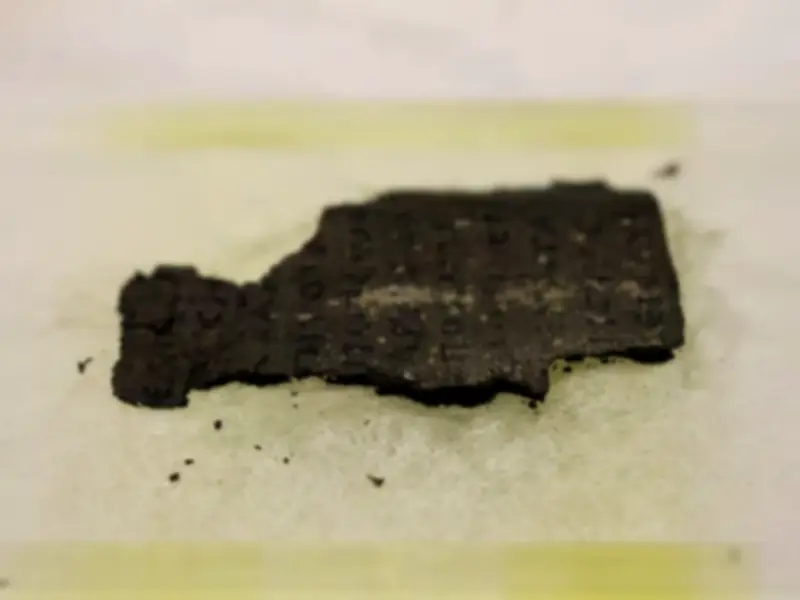
Researchers using artificial intelligence and advanced imaging announced on Thursday that they had successfully read a closed Herculaneum scroll for the first time. The scroll, burnt by the eruption of Mount Vesuvius nearly 2,000 years ago, was deciphered non-invasively, marking a breakthrough in the study of ancient manuscripts from the Roman town destroyed along with Pompeii in 79 AD.
Breakthrough in Virtual Unwrapping
The blackened, fragile scrolls cannot be physically opened without severe damage. Instead, researchers employed high-resolution scans and computational techniques to virtually unwrap them and detect ink on the papyrus layers. So far, about 45 papyrus scrolls and fragments have been scanned, with more than 600 unopened scrolls remaining. Large parts of the villa where they were discovered have yet to be excavated, raising the possibility of further finds.
Brent Seales, professor of computer science at the University of Kentucky and a founder of the project, said, "Just a year ago it would have been crazy for any of us to believe that there would be a complete scroll read completely non-invasively with hundreds of columns of text. Today we have shown you that that is possible." He added, "I believe we're going to read every single one of the scrolls in the collection."

Vesuvius Challenge and Prize Incentives
To accelerate scholarship, the Vesuvius Challenge is promoting new technologies to understand the carbonized text. The project announced it would place all its data, code, and models of the papyri online and offer a $1 million prize to the first person or team to read in full any other scroll. Already, the challenge has awarded $1.8 million in prizes for work linked to unmasking the Herculaneum texts.
Nat Friedman, a US technology executive and founding sponsor of the project, said, "We think it is possible to dramatically improve the algorithms that we have ... and we think that the ink detection techniques that we're using could probably be greatly advanced." He encouraged more computing experts to get involved.
Uncovered Text Explores Ethics, Arts, and Human Behavior
Among the new material presented on Thursday were 70 columns of text from "On Vices, Book 1," attributed to the Epicurean philosopher Philodemus. Nearly 1.5 meters of readable text across 20 columns was also recovered from a document dated to 200–300 BC—the oldest Herculaneum scroll yet unwrapped—exploring ethics, arts, and human behavior.
Federica Nicolardi, lead papyrologist for the Vesuvius Challenge, said new technologies were transformative. "Even with the most successful methods available ... to physically unwrap the scrolls and read them, one had to damage them. But with virtual unwrapping, we are no longer forced to choose between preserving and reading these extraordinary artefacts. We can do both."
Nicolardi noted that progress was snowballing. In the last 24 hours, researchers unwrapped the full length of one scroll, producing about 140 columns of new text. Until recently, they were only uncovering about 10% of columns. "Literally last night, in front of Mount Vesuvius, something, or I should say everything, changed," she said.