No man is an island, entire of itself; nor is a religious civilisation. Islam as a subject which I teach and a religious civilisation to which I belong lives under a cloud of suspicion, hostility, and ignorance. It puts ordinary individual Muslims on the defensive, having to constantly explain that they belong to a religion that promotes peace, not violence.
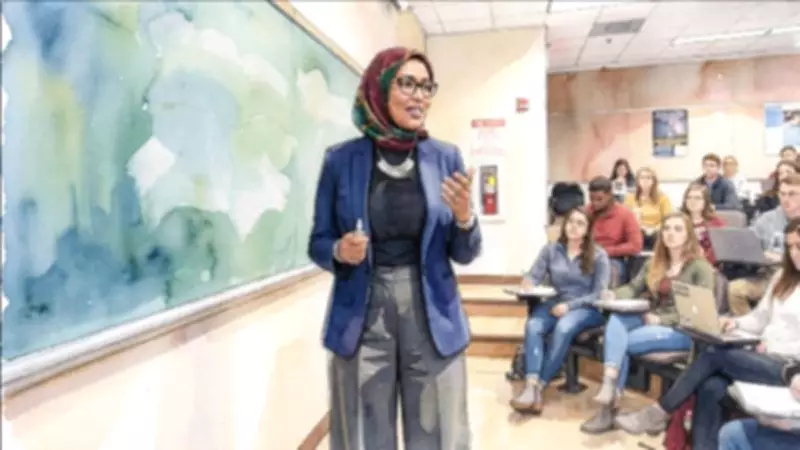
I teach a popular course called 'The World of Islam' at American University, Washington, DC. I have now been teaching the course for over two decades. I frequently discuss topics relating to Islam in the media, I have made films, written many books and studies, and despite sitting continents and oceans away, I have regularly edited work and written references and blurbs for scholars across the world and assisted them in the crucially important task of education about Islam.
In this current global miasma that surrounds Islam, the religion is imagined as a vague predatory threat that challenges the very way of life of people in the West. Knowing little about Islam or its history, the religion is clearly cast as the quintessential antagonist, as 'them' against the embattled 'us'. Every incident anywhere in the world is immediately fed into the global perception that Islam is a threat to the very basis of Western civilisation.

The reality is very different and may perhaps allow us to see Islam through a different lens. It is well to keep the symmetry at Bondi Beach in Australia in mind: the attacker who so heartlessly murdered the peaceful Jewish community was Muslim, but so was the sole saviour. Prominent politicians and media commentators were freely describing Islam as a cancer that had to be removed. Unrestrained statements inciting violence against Muslims went unchecked.
I often reminded myself that according to polls some 60 per cent of Americans thought that Islamic and American values were incompatible. Across the Muslim world, Muslim nations were being reduced to rubble—Syria, Afghanistan, Iran, and Palestine before it was even born. Muslims wondered who was next. Turkey or Pakistan? My task as a teacher of Islam was thus, at the start of every term, an uphill one.
How Decades of Hostility Led to War - Part 1
In this current global miasma that surrounds Islam, the religion is imagined as a vague predatory threat that challenges the very way of life of people in the West. Yet the global inter-penetration, overlap, and synthesis between Muslims and non-Muslims is nothing short of amazing. It will dispel the shroud of ignorance covering Islam that sees Islam as the eternal hostile outsider. Consider the following examples:
Rumi, the great Muslim mystic poet, is prominently featured in the movie KPop Demon Hunters (2025). Jack Sparrow, immortalised by Johnny Depp in Pirates of the Caribbean, was based on Jack 'Sparrow' Ward, an English convert to Islam. The name of Miss Universe (Fátima Bosch Fernández) is Fátima, a name historically inspired by the daughter of the Prophet of Islam (PBUH). The University of al-Qarawiyyin, the oldest university in the world which is still giving degrees, is situated in Fez, Morocco, and was created by Fatima al-Fihriya—also a name inspired by the Prophet's (PBUH) daughter. President Barack Obama's name includes the name Hussein, which is the name of the grandson of the Prophet of Islam (PBUH).
Frederick II, the mighty medieval Holy Roman Emperor, had great respect for Islam, spoke Arabic, had Muslim bodyguards, and had Arabic writing on his royal ceremonial mantle, which was worn by the Holy Roman Emperors at their coronations until the late 18th century. Common American cultural features, such as the taco and cries of 'Olé!' in appreciation, are inspired by Muslim Spain. Olé is in fact derived from 'Ya Allah!'. One of the wonders of the world, the priceless Taj Mahal, was built by a Muslim and dedicated to his Muslim wife. Aladdin, popularised by Disney, derives his name from 'Allah din' or the religion of Allah.

What about Islam as the enemy of Christianity? Didn't we have to fight them during the Crusades? Surely, they must reject and mock our Lord? No; on the contrary. Jesus is highly revered in Islam and mentioned more often than the Prophet of Islam (PBUH) in the Quran. His birth is miraculous, and he can perform miracles. The Prophet (PBUH) said no one has greater love and reverence for Jesus than he does. Mary has an entire chapter in the Quran dedicated to her.
Did Ali Shariati Use Islam As a Tool for Social Change?
While President Trump speaks about a Muslim ban, some of his closest allies are Muslim: Prince Muhammad bin Salman of Saudi Arabia and Tamim bin Hamad Al Thani, the Emir of Qatar, for example. In the White House, Trump received the prince one day, and three days later he greeted Zohran Mamdani, the first Muslim mayor of New York, warmly. Trump has on several occasions in public called General Asim Munir, head of the armed forces of Pakistan, 'my favorite Field Marshall.' Trump also named Muslims to top positions such as Dr Mehmet Oz, head of the Centers for Medicare and Medicaid Services (CMS).
Michael Hart, the American Jewish Professor, selected the Prophet of Islam (PBUH) as the number one most influential figure in history from his list of the top one hundred in the book of the same title. In a more recent edition, Hart again selected the Prophet (PBUH) as number one. There is no figure like him in history, he explained—he created a state where none existed, introduced a new religion, led armies into battle, provided a corpus of laws to his community, and ensured safeguards for women and the minorities. Goethe and a Chinese Emperor wrote beautiful poems in honour of the Prophet of Islam (PBUH), and Benjamin Franklin, Napoleon, George Bernard Shaw, and Mahatma Gandhi expressed their admiration for him.
The name Muhammad, inspired by the Prophet of Islam (PBUH), is the most popular name among Muslims in the UK. Many great Western cities such as London, New York, and Rotterdam, and more than a dozen cities in the UK, have had Muslim mayors. There are several female Muslim mayors in the UK.
The respect for learning and wisdom was at a premium during the Golden Age of Islam, a period between the 8th and 14th centuries, where Muslims were at the cutting edge of the various disciplines of knowledge. Ibn Firnas in the ninth century was the first man to attempt flight. There is a bridge in the form of wings commemorating Firnas in Cordoba where he lived, and a crater on the moon honours him. Ibn Rushd, the great philosopher of Andalusia, influenced St Thomas Aquinas, who referred to him more than 500 times. Ibn Rushd also has a crater on the moon named in his honour and is featured in a painting by Raphael, 'The School of Athens,' which also features Socrates and Plato and is housed in the Vatican.
Fractures Within Power: Iran, Intelligence, And The Politics Of Perception In America
Other great classical Muslim scholars were similarly influential to our modern age. Al-Jazari was called the father of robotics for his scientific discoveries—he discovered what would become in time the steam engine. Al-Haitham invented what would be known as the camera obscura and would lead to Hollywood. Al Khwarizmi invented algebra, algorithms, and the astrolabe. Ibn Sina wrote The Canon of Medicine which would be taught in Western Universities for the next 700 years. Ibn Tufail's novel about a man who grows up isolated on an island inspired Robinson Crusoe and would go on to inspire John Locke, whose work in turn influenced Thomas Jefferson.
The Muslim Mughal prince Dara Shikoh's translation of the Hindu text The Upanishads carried out in India was picked up in Europe by philosophers like Schopenhauer, and the more philosophic concepts of Hinduism became popular in Europe. Ibn Khaldun was known as the father of anthropology and sociology. Astronomy was a great favourite of the Muslims and, as a result, many of the stars and planets are named after Arab astronomers. Muslim rulers established high moral ideals in governance, justice, and compassion. The examples of Umar and Ali, the second and fourth Caliphs of Islam, and Saladin Ayubi, who re-gained Jerusalem from the Crusaders, are widely recognised.
Islam, however, is commonly today used as a tool to make amorphous and vague insinuations against Muslims. In foreign policy, if you want to target Iran, for example, you may simply blame Islam; if you want to target immigrants in Minnesota in the US, you may blame Somalis. If an individual Muslim commits an act of violence or terror, the religion of Islam will be blamed, whereas if a non-Muslim commits a similar act, it will be attributed to mental health problems. Every time they join my class, I am aware students are coming fresh from the exposure to media and the general perception that Islam is coloured, if not defined, by attacks on the USA, Osama Bin Laden, ISIS, Al-Qaeda, and that Islam is inherently violent, ignorant, foreign, and alien.
Still, most students are enthusiastic and keen to learn, and some even complain that American high schools teach them little to nothing about Islam. Some are exceptionally bright; most make an effort to learn, even those who may be innately hostile to the subject. My aim is to teach them the reality of Islamic culture and history, not to promote propaganda or falsehood. As a Muslim living in the West where Islamophobia and stories of violence committed by Muslims appear regularly in the media, it is a difficult task. I believe it is vitally important to build bridges.
An Anthropological Gaze On Power: Personalised Authority And Political Performance In Contemporary America
In my class, we cover the Golden Age of Islam, when Muslims, Jews, and Christians created a rich and glittering culture of innovation and inclusivity—what the Spanish call La Convivencia or Coexistence. I point out that Islam is about piety, prayers, and faith, but it is more. It is about respect for knowledge, it is also about respect for the community and for the need to take special care of the poor and vulnerable, and to heed the earth and nature. In the most profound sense, Islam exemplifies John Donne's saying, 'No man is an island, entire of itself; every man is a piece of the continent, a part of the main.'
We also focus on the interaction between Christians and Jews and their relationship to Islam. We discuss what is common between them, and what are the points of difference. I remind the class of figures like the Caliphs Umar and Hazrat Ali and that of Sultan Saladin and their compassion in dealing with non-Muslims. I maintain a strong interfaith aspect in my teaching without compromising the integrity of the faiths. Even in the worst days of the genocide in Gaza, I invited Walter Ruby and Dr Sabeeha Rehman, who have promoted Jewish-Muslim dialogue and wrote We Refuse to Remain Enemies. They were a good example of civilised and sensible conversation, in spite of the retreat of such dialogue elsewhere in the land.
There were sessions on Muslim women—those from the early part of Muslim history like Hazrat Khadijah, Fatima, Zainab, and Aisha, and more contemporary figures like Benazir Bhutto, Malala Yousafzai, and Sharmeen Obaid-Chinoy, the famous movie director who won an Oscar and will direct an upcoming Star Wars film. Students were aware of the stereotypes in the media and keen to learn the truth. By the time the term concludes, and students are writing the final paper, several of them are of such a high standard as to leave me astonished at the high quality. They reflect learning, wisdom, and imagination. They make me feel very proud and make the whole business of teaching worthwhile.
Who Is Exhausted Now? America, Iran, And The End Of The Hegemonic Age
Some of my students have gone on to take up important positions in the State Department, academia, and media; several went on to Oxford and Cambridge. They have done well, and I am proud of their achievements. I have tried scrupulously for transparency in teaching. I do not disguise my Islamic background but lay out the arguments for and against the subject we are discussing. I will cite both Edward Said and Bernard Lewis when discussing Orientalism. But most importantly, I emphasise that my students develop their own critical faculty in the manner of Socrates—so ours are Socratic dialogues. I also quote the Greek philosopher when he was called the wisest of men: 'the only thing I know is that I know nothing.' Through education pursued in the manner of Socrates, we can reach a better understanding of what Islam actually is, not its common distortions.
Islam comes with a clear vision of the world rooted in the concept of a caring and compassionate God and a spiritual vision that encourages followers to work to uplift humanity and promote harmony—in short, an antidote to what the Germans conceptualize as Weltschmerz or the pain of the world. This knowledge should be cause for optimism and hope. The political and intellectual elite of the United States should be moving in a positive direction, reinforcing the vision of their own Founding Fathers, whose main idea of their new country was based in religious pluralism. Unfortunately, too many of them are advocating the opposite: deport Muslims, ban them, and feel free to abuse Muslims and spread dangerous slander about them.
I really wish they could sit in on my classes: perhaps they would learn about Muslim history and tradition, which they have seen demonised and, as a result, been deprived from learning about its history and culture. Let me conclude by repeating what I share with my students. It is the broader vision of the Founding Fathers that several American presidents, including Eisenhower and Kennedy, who visited American University, described as an America that represents morality, compassion, stability, harmony, and the promotion of knowledge. It is here where America aspires to its noblest ideals and inspires the world.