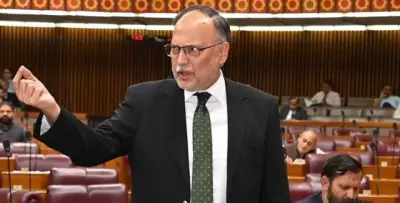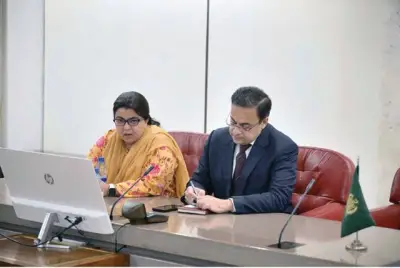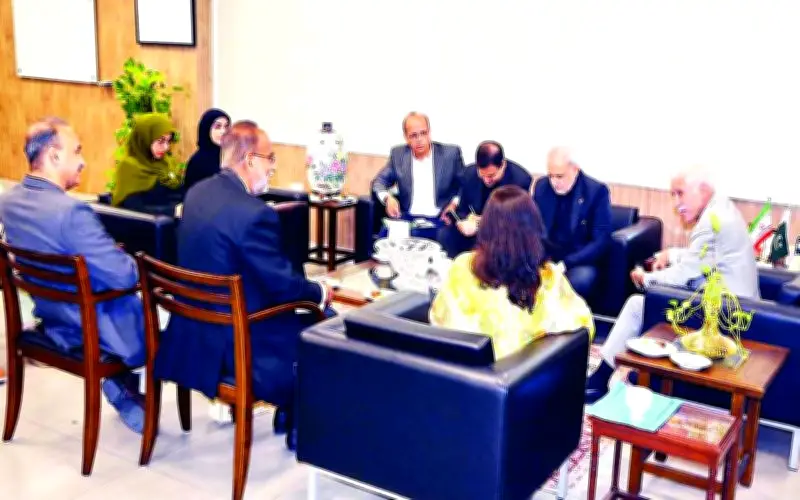
ISLAMABAD - Federal Minister for Investment Qaiser Ahmed Sheikh held a comprehensive meeting with the Ambassador of the Islamic Republic of Iran to Pakistan, Reza Amiri Moghadam, to further strengthen bilateral economic cooperation and address key issues related to trade, investment, and regional connectivity.
Warm Welcome and Gratitude
The federal minister warmly welcomed Ambassador Reza Amiri Moghadam, who expressed gratitude for the minister’s time and engagement. The discussions focused on enhancing economic relations in light of the already signed Memorandum of Understanding (MoU) between Pakistan and Iran for the establishment of Joint Free/Special Economic Zones (SEZs) along their shared border. The MoU forms part of a broader framework aimed at significantly increasing bilateral trade and economic integration.
Commitment to $10 Billion Trade Target
Both sides reaffirmed their commitment to achieving the agreed bilateral trade target of USD 10 billion in the coming years. During the meeting, detailed discussions were held on the operationalization of the SEZ. The Iranian side emphasized the need for a joint visit to finalize and notify the boundaries of the economic zone. While Iran has already completed demarcation on its side, Pakistan’s side requires coordination to move forward. It was agreed that a joint technical visit would be undertaken as a first step, followed by the development of Terms of Reference (TORs). The minister highlighted the strategic importance of the location.

Resolution of Stuck Containers at Karachi Port
The meeting also addressed the issue of Iranian containers currently stuck at Karachi Port for approximately 100 days. Ambassador Moghadam requested Pakistan’s support for their early release, particularly as some consignments include essential goods such as medicines. The minister assured that the Board of Investment (BOI) would obtain detailed information and coordinate with relevant ministries to resolve the matter on priority.
Reviving Cross-Border Trade Volume
Both sides expressed concern over the decline in cross-border trade volume. It was noted that prior to recent tensions, approximately 700–800 trucks were crossing the border daily, which has now decreased significantly. The two sides discussed enhancing this number, with a potential target of up to 2,000 trucks per day. The ambassador also highlighted Iran’s readiness to provide Pakistan enhanced access to Central Asian markets. Both sides agreed to actively promote joint ventures and encourage private sector collaboration.
Strategic Opportunity and Implementation Challenges
The minister emphasized that current developments present a timely opportunity to expand trade through both land and sea routes. He acknowledged that while the SEZ initiative has been agreed at the highest level, implementation challenges remain, particularly in coordination with provincial governments as well as external geopolitical factors. The minister stated that the Special Investment Facilitation Council (SIFC) would be engaged to coordinate with provincial authorities to address these challenges. He reaffirmed that the Board of Investment would take a proactive lead in advancing this initiative.
Regional Prosperity and Urgent Action
Appreciating Iran’s forward-looking approach, the minister remarked that such strategic thinking is vital for regional prosperity. He emphasized the urgency of resolving outstanding issues and accelerating implementation. It was agreed that the Iranian side would formally share a comprehensive communication outlining key concerns, enabling the Board of Investment to convene an inter-ministerial meeting for coordinated action.