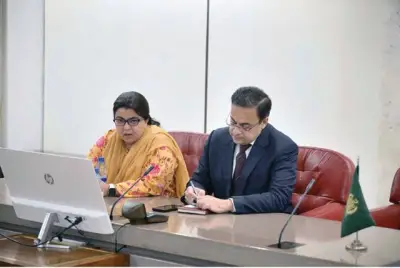
ISLAMABAD - The Pakistan Institute of Development Economics (PIDE) has highlighted that Pakistan requires an estimated $152 billion for adaptation and resilience between 2023 and 2030, but only about $4.5 billion has been disbursed so far. Experts warn that a failed monsoon could trigger the country's next economic crisis.
Climate Risk and Agriculture
Pakistan must shift from reactive disaster relief to climate-risk management as climate shocks threaten agriculture, food security, rural livelihoods, and economic stability, experts warned at a roundtable hosted by PIDE. The warning comes ahead of Pakistan's uncertain 2026 monsoon. The dialogue, titled “Climate Risk and Agriculture Sector Output: Policy Pathways for Monsoon 2026 and Beyond,” was organized by PIDE’s Centre for Agriculture, Climate Change and Rural Economy (CACCRE). The event brought together experts from PMD, NDMA, NUTECH, NUST, GIZ, Ghazi University, the Planning Commission, academia, development organizations, and the private sector nationwide.
Opening Remarks
Opening the session, Dr. Nasir Iqbal, Registrar at PIDE, said climate change is no longer only an environmental concern but a challenge to productivity, inflation, employment, public finance, and growth. “The next economic crisis may begin not with a failed bank, but with a failed monsoon,” he warned. Agriculture contributes about 23.4 percent of Pakistan’s GDP and supports more than 33.1 percent of its workforce, yet remains severely exposed. Nearly 70 percent of farmers cultivate fewer than five acres, while less than two percent of agricultural losses are insured. “Every rupee spent rebuilding is a rupee not invested in our future,” Dr. Iqbal said, calling for a move from disaster response to risk management, relief to resilience, and fragmented institutions to integrated governance. Farmers, he stressed, need fair markets, quality seeds, technology, and protection.

Preliminary Assessment
Presenting CACCRE’s preliminary assessment, Dr. Inayat Ullah, Chief of Research and Director CACCRE, said the study covered 121 districts, three major crops, and 10 agro-ecological zones using data from 1998 to 2024. The findings showed that warming is accelerating fastest in rain-fed and southern irrigated belts. Districts in southern Punjab and interior Sindh repeatedly appeared at the intersection of food-security importance, climate vulnerability, weak irrigation, and unequal land distribution. Participants urged coordinated support for these critical areas.
Adaptation Financing Gap
The assessment also highlighted a severe adaptation-financing gap. Pakistan requires an estimated $152 billion for adaptation and resilience between 2023 and 2030, while only about $4.5 billion had been disbursed following the 2022 floods by mid-2025. Experts called for anticipatory finance, wider agricultural insurance, and stronger private-sector participation. Low productivity was another concern. Much of Pakistan’s agricultural growth has come from cultivating more land rather than improving yield. Wheat yields remain around 2.8 to 3.1 tonnes per hectare against an achievable potential of five to six tonnes. In 2024–25, wheat output declined by 8.9 percent, cotton by 30.7 percent, and maize by 15.4 percent. Participants recommended climate-resilient seeds, research, efficient irrigation, modern extension services, storage, and market reform.
Livestock Vulnerability
Livestock, which contributes about 63.6 percent of agricultural value added, was identified as highly vulnerable to heat, disease, and flooding. Dr. Mohsin Kiani, Livestock Specialist at the Planning Commission, said climate-smart feeding, including total mixed rations, could raise productivity by 15 to 20 percent while reducing emissions by 10 to 15 percent. He called for livestock insurance, recognition of insured animals as collateral, lower taxes on agricultural technology, and stronger private-sector engagement.

Meteorological Outlook
Dr. Faisal Saeed, Chief Meteorologist at PMD, said the seasonal outlook indicated above-normal temperatures and a greater probability of a suppressed monsoon. He cautioned that lower seasonal rainfall does not eliminate the danger of intense downpours, flash floods, or localized extremes. Experts warned that reduced rainfall could create Kharif water shortages and called for district- and crop-specific advisories.
Disaster Management Insights
Representing NDMA, Dr. Kamal Ahmed, Executive Director Risk Finance, said losses are rising because of poor land-use planning, vulnerable infrastructure, and inadequate preparedness. He noted that the 2022 floods caused substantially greater economic damage than the 2010 floods despite being comparatively weaker hydrologically. “We have early-warning systems, but these early-warning systems do not translate into early actions,” he said, urging anticipatory financing and institutional coordination.
Technology and Data Integration
Dr. Maryam Jalal, Professor at NUTECH, proposed a national intelligent platform integrating meteorological, agricultural, satellite, and disaster-risk data. “The data must become the decision, and technology must become action,” she said, advocating climate-smart irrigation, precision farming, rainwater harvesting, and resilient crops.
Behavioral Science Perspective
Dr. Imran Lodhi, Lead Behavioral Scientist at the Climate Behavioral Lab, Ghazi University, stressed that information alone will not change farming practices. Farmers interpret uncertainty through trust, experience, and local networks, he said, calling for evidence-based behavioral frameworks that turn climate risk into practical solutions, especially for small and medium farmers.
Policy Pathways
CACCRE presented six policy pathways covering early-warning systems, climate-smart water governance, agricultural adaptation, risk financing and insurance, research and innovation, and institutional integration. Immediate priorities for Monsoon 2026 included converting forecasts into farm-level guidance, expanding resilient seeds, protecting livestock, strengthening district preparedness, and activating anticipatory finance. Longer-term reforms should modernize research and extension, expand insurance, improve markets and storage, and establish coordination across federal, provincial, and local institutions.
Concluding Remarks
Concluding the dialogue, Dr. Shujaat Farooq, Dean (Research) at PIDE, said Pakistan does not lack policies or institutions, but implementation, integration, and effective governance.