State engineering of qawwali in Pakistan began in the early 1950s when the government used the genre on state radio to counter Islamist narratives. This marked a shift from the initial exclusion of qawwali, which was deemed incompatible with the state's vision of a refined modern Muslim identity. The evolution of qawwali reflects Pakistan's broader cultural and political struggles, from the trauma of Partition to the military dictatorships and populist movements.
Partition and the Birth of Pakistan: A Cultural Void
Pakistan came into being on 14 August 1947, amid brutal violence and mass migration. The traumatic two-way migration of Hindus and Muslims across new borders left a trail of casualties and destruction. The new nation's urban centers, Karachi and Lahore, filled with Muslim migrants from India, mainly Punjabi and Urdu-speaking Muhajirs. While Punjabis integrated quickly, Urdu-speakers settled in Sindh, forming a majority in Karachi, which became the federal capital. The Muhajir community quickly occupied key positions in bureaucracy and the economy.
Unlike India, Pakistan's founding party, the Muslim League, rapidly fragmented, leaving a vacuum filled by the military and bureaucracy. Founder Muhammad Ali Jinnah defined Pakistan as a Muslim-majority nation, asserting cultural separatism based on the ideas of Syed Ahmad Khan and Muhammad Iqbal. They formulated a 'cultural secularism' that detached Islam's cultural dynamics from theology. Jinnah rejected theocracy, envisioning Pakistan as a refuge for minorities. After his death in 1948, the state began shaping national culture, but failed to forge consensus among diverse ethnic and sectarian communities.

Early State Cultural Policy: Sidelining Folk Traditions
Between 1947 and the early 1950s, Radio Pakistan's airwaves were dominated by Urdu/Hindi film soundtracks, classical music, and patriotic anthems. Regional folk traditions were sidelined due to fears of provincialism. Qawwali, traditionally performed in Punjabi at Sufi shrines, was rarely broadcast. The state and urban bourgeoisie viewed Islam through a modernist lens, aiming to export urban modernity to rural areas and bind the nation into a homogenous culture.
However, millions continued to practice folk traditions at Sufi shrines, performing qawwali, qawwali dance, and dhamal. These expressions were ignored by urban cultural patrons. For instance, snake-charmers from Sindh were unnoticed until American jazz musician Dizzy Gillespie visited Karachi and was photographed jamming with a traditional pungi player, prompting local media attention.
The 1953 Crisis and the Weaponization of Qawwali
In 1953, the state used military force to crush a violent anti-Ahmadiyya movement by Islamist groups. To counter fundamentalist literature, the government distributed pamphlets by modernist scholar Khalifa Abdul Hakim, arguing that Iqbal's philosophy was incompatible with orthodox Islam. Shaken by the riots, Radio Pakistan introduced qawwali to the airwaves as a calculated ideological maneuver. By 1955, the government commissioned qawwalis in Urdu, incorporating Iqbal's poetry, stripping the genre of its esoteric mysticism and replacing it with nationalistic themes.
This state-sanctioned qawwali was first presented to mass urban audiences. By the late 1950s, Radio Pakistan eased boundaries, permitting Urdu qawwalis with mystical themes. The genre surged after the 1958 coup by Ayub Khan, whose industrialization drive triggered rural-to-urban migration. During Ayub's first seven years, Pakistan experienced unprecedented economic growth. The state championed 'Islamic modernism', encouraging theological flexibility.
Ayub Khan's Islamic Modernism and Qawwali's Expansion
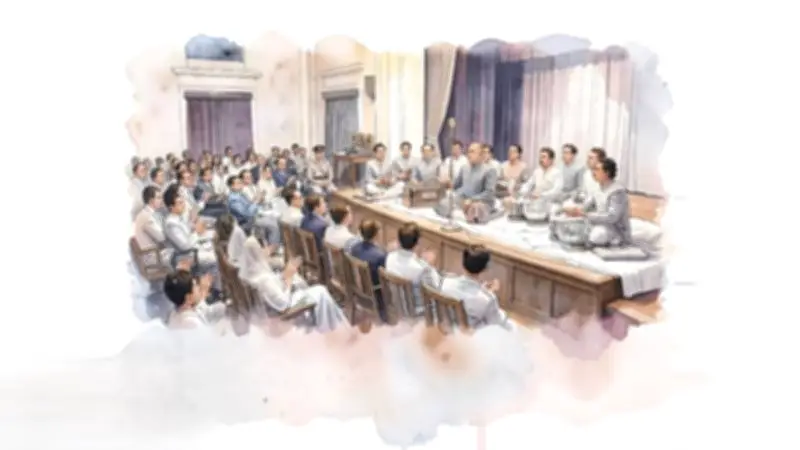
The expansion of Urdu qawwali was boosted by EMI-Pakistan, the largest record label. Qawwali groups like the Sabri Brothers fused traditional Punjabi spiritual imagery with Urdu poetry, shaping modern Urdu qawwali. In 1960, Radio Pakistan broadcast live qawwali sessions every Thursday night, primarily featuring the Sabri Brothers, but with strict conditions: performances in Urdu, and lyrics avoiding conflict with the regime's Islamic modernism.

Initially popular in Karachi, the new Urdu qawwali attracted urban middle and elite classes who hosted private qawwali evenings. Young qawwals like Aziz Mian balanced performing traditional Punjabi qawwalis at shrines and polished Urdu sets for elites. However, by the late 1960s, the Ayub regime faced resistance from marginalized groups and blocked middle-class aspirations. In 1968, the economic narrative collapsed, and suppressed ethnic and political diversity erupted, leading to Ayub's fall in 1969.
Bhutto's Populist Islamic Socialism and the Golden Age of Qawwali
The 1970 elections split the country regionally. The Bengali nationalist Awami League won a majority in East Pakistan, while Zulfikar Ali Bhutto's PPP swept Sindh and Punjab. The West Pakistan establishment delayed power transfer, leading to rebellion, civil war, and India's intervention, resulting in the secession of East Pakistan and creation of Bangladesh in 1971. Bhutto became president, and his government remodeled state ideology into 'Islamic socialism', fusing left-wing economics with Islamic egalitarianism and folk Islam.
This opened avenues for regional folk artists and qawwals. Radio Pakistan and PTV integrated Sindhi, Punjabi, Baloch, and Pashtun performers. Folk music was realigned with a vision of federalism celebrating pluralism. EMI-Pakistan released numerous Urdu qawwali albums recorded in Karachi. The two premier exponents were the Sabri Brothers and Aziz Mian. This period saw the crystallization of 'Pop Sufism', with folk singers and qawwals captivating urban audiences.
The early 1970s saw a rise in young urbanites visiting Sufi shrines. However, the urban middle-classes experienced a romanticized version of Sufism through media. The Bhutto administration framed Sufi saints as early socialists, while urban patrons often stripped religious themes, transforming devotion into mainstream entertainment. The naat genre also gained prominence; in 1974, PTV broadcast Qari Waheed Zaffar's Allah Hoo Allah, which became a sensation after echo and reverb effects were applied.
Aziz Mian vs. Sabri Brothers: The Rivalry That Defined an Era
Aziz Mian, born in 1942 in Delhi, migrated during Partition and learned qawwali at the Data Ganj Bakhsh shrine in Lahore. He earned master's degrees in Urdu, Persian, and Arabic literature. His 1974 release Sharabi by EMI-Pakistan propelled him to stardom. The track featured his distinctive style: slow build, infectious chorus, then a blistering spoken argument to God. He used intoxication as a metaphor for divine love. A cultural writer dubbed him "the Nietzschean Sufi."
The Sabri Brothers, known for their melodic style, also gained massive popularity. A fierce rivalry ignited. The Brothers mocked Aziz Mian for lacking melody, and disapproved of his praise of wine. In 1976, Aziz Mian expanded Sharabi to nearly 50 minutes, selling out within months. The Sabri Brothers released Bhar Do Jholi, featured in the film Bin Badal Barsat. The Brothers retaliated with O Sharabi, Chhor De Peena, a taunt at drunkards. Aziz Mian responded with Hai Kambakht, Tu Nein Pe Hi Nahi, mocking the Brothers for not understanding divine intoxication. According to EMI-Pakistan, combined sales of both acts surpassed two million LPs and cassettes in 1977 alone.
Zia-ul-Haq's Islamist Dictatorship and the Decline of Qawwali
In July 1977, General Zia-ul-Haq's coup toppled Bhutto. Zia promoted a stringent Islamism but did not ban Sufism; instead, he redefined Sufis as orthodox scholars rooted in Sharia. State patronage for folk music continued, but its soul altered. Urdu qawwali receded; folk artists were redirected to patriotic anthems. For instance, Sindhi folk singer Allan Fakir performed Tu Ne Pakistan Diya on PTV. Sufi music was stripped of its esoteric traits and populist edge, becoming entirely nationalized.
After steady decline in the 1980s, Urdu qawwali resurged in the 1990s with Nusrat Fateh Ali Khan. He had been performing since the 1970s but was overshadowed by Aziz Mian and the Sabri Brothers. His breakthrough came in 1988 when Peter Gabriel featured his vocals on the soundtrack for Martin Scorsese's The Last Temptation of Christ. Nusrat recorded successful Urdu and Punjabi qawwalis, courted by Western pop icons and Pakistani celebrities. This Sufism was reimagined for urban middle and upper-middle classes and westerners, not requiring shrine visits. Nusrat's death in 1997 temporarily rekindled interest, but qawwali never regained its 1970s dominance.
Conclusion: The Domestication of Qawwali
Originating in 13th-century South Asia, qawwali evolved into a fixture of Sufi shrines by the 18th century. Pakistan's early elites initially excluded it, but from the 1950s, the state weaponized it to counter Islamists. Under Bhutto, qawwali reclaimed its populist edge, serving as an emotional valve after the 1971 war. However, Zia's regime rewrote Sufism, fracturing the genre. In ensuing decades, qawwali lost its political utility and spiritual rebellion, becoming a casual fixture on music streaming lists and wedding playlists. Stripped of its edge, it was domesticated.