June is the last month of an outgoing financial year, while the new financial year begins on the first day of July. As such, it is mandatory for the federal government to present the budget for the next fiscal year in the National Assembly for discussion and approval before midnight on June 30. Resource mobilisation is essential to meet recurring as well as development expenditure. At the federal level, resources are generated through a well-coordinated and concerted effort by revenue-collecting agencies and administrative units. All revenues collected by the agencies and administrative divisions of the federal government, all loans raised, and all money received as repayments of loans form part of the Federal Consolidated Fund.
Accordingly, the largest coalition federal government, headed by Prime Minister Muhammad Shehbaz Sharif, presented its third budget in the National Assembly on June 12, 2026. Initially, the new federal budget was to be presented on June 10, but it was delayed by two days to allay the apprehensions and reservations of some coalition partners and ensure their support for the passage of this nationally important document, full of figures. Once the federal budget was presented, it was followed by the presentation of the provincial budgets of Punjab, Sindh, Khyber Pakhtunkhwa and Balochistan in their respective legislatures.
As usual, the Washington, USA-headquartered International Monetary Fund (IMF) was involved in the preparation of the new federal budget from start to finish. Since joining the IMF in 1955, Pakistan has sought financial assistance a total of 25 times to help boost foreign reserves, prevent balance of payment crises and manage fiscal deficits. Pakistan and the IMF share a long-standing relationship of financial support and economic reforms, which has since evolved into a 37-month Extended Fund Facility (EFF) of approximately US$7 billion. The programme strictly focuses on maintaining fiscal discipline, broadening the tax base and restructuring State-Owned Enterprises (SOEs). This was not all. The IMF office in Islamabad quietly keeps monitoring ongoing progress on the federal budget announced after an agreement with the Fund.

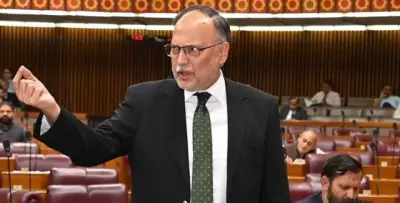
Federal Finance Minister Senator Mohammad Aurangzeb presented the Rs18.77 trillion budget with a focus on growth and relief, in the presence of PM Shehbaz Sharif, who was making one of his rare appearances in the national legislature. The federal budget for financial year 2026-27 has raised defence spending and squeezed development expenditure to meet IMF goals. Broadly speaking, the federal finance minister, in his budget speech, announced a meagre 7 percent increase in salaries of government employees and pensions. He also announced Rs1,000 billion for the Public Sector Development Programme (PSDP) for the implementation of a little more than 800 ongoing and new schemes by 37 ministries and divisions of the federal government. The growth rate target has been fixed at 4 percent against 3.7 percent achieved during the outgoing fiscal year, while the minimum wage has been increased by 10 percent. Income tax rates have been reduced for the salaried class across all four tax slabs, the surcharge on the salaried class is to be abolished, imported vehicles above 3000cc and luxury electric vehicles are to be taxed, and super tax on many industries and businesses is to be abolished.
Through the budget for financial year 2026-27, the federal government has cut all sorts of subsidies by 5.7 percent to Rs1.09 trillion. The main tax-collecting and revenue-generating agency, the Federal Board of Revenue (FBR), has been tasked with collecting Rs15.26 trillion, including revenue to be collected through new or increased taxes. Inflation has been projected at 8.2 percent, the budget deficit at 3.6 percent of Gross Domestic Product (GDP), and the primary surplus at 2 percent of GDP for FY 2026-27. While announcing a number of welfare measures for different segments of society, the coalition federal government has done no justice at all by increasing the salaries and pensions of serving and retired public servants only by the single digit of 7 percent, thus upholding its tradition of keeping this increase in single digits, quite regretfully. The federal government should raise this little welfare measure into double figures, to around 20 percent if not more than that, please.

There was also a dire need to pull up most federal ministries and divisions to ensure timely utilisation of allocated and released funds under the PSDP for the timely completion of more and more development schemes. These schemes are aimed at providing maximum possible welfare and well-being to people in urban and rural areas through the provision of a host of facilities in terms of infrastructure, health, education, housing, etc. As per the latest available data, the 37 ministries and divisions had spent only Rs529 billion in eleven months by the end of May 2026, which was only 52 percent of the allocated and authorised development funds under the PSDP 2025-26. Is this not deplorable, regrettable and shameful, to say the least? All ministries and divisions should be pulled up to ensure the least time and cost escalations of their listed development projects. Progress regarding the implementation of development projects and utilisation of allocated and authorised funds must be reviewed more frequently and regularly, and the public should be duly kept informed in this regard.
Muhammad Zahid Rifat
The writer is Lahore-based Freelance Journalist, Columnist and retired Deputy Controller (News), Radio Pakistan, Islamabad and can be reached at zahidriffat@gmail.com