The village of Shah Jewna in central Punjab, Pakistan, offers a living counter-narrative to sectarian violence. Here, during the month of Muharram, Sunni Muslims build towering taziyas—funeral biers symbolizing the martyrs of Karbala—for the Shia minority, while Shia devotees mourn the tragedy of 680 AD. This tradition, rooted in the teachings of the Sufi saint Hazrat Shah Jewna, has endured for over a century, fostering interfaith solidarity in a region otherwise known for anti-Shia militancy.
The Origins of Azadari and the Tragedy of Karbala
Shia Islam centers on the legacy of Prophet Muhammad (PBUH) and his family. The defining event is the martyrdom of Imam Hussain, the Prophet's grandson, at Karbala in 680 AD. He and 72 companions, including male relatives, were killed by the forces of Caliph Yazid. Survivors, mostly women and children, were imprisoned and paraded to Damascus. Denied the right to mourn, Imam Hussain's sister, Syeda Zainab, and his son, Imam Zain ul Abideen, initiated Azadari—collective mourning rituals to preserve the memory of the sacrifice. This mourning period spans 60 days during the Islamic months of Muharram and Safar, culminating on Ashura.
Subsequent persecution of Shia Imams—none of whom died naturally—led to the practice of Taqiyya, or concealing one's faith for survival. Over centuries, Shia communities migrated to the Indian subcontinent, carrying their traditions.

Hazrat Shah Jewna: A Saint's Legacy
Hazrat Shah Jewna, born Syed Mehboob-e-Alam, was a descendant of the tenth Shia Imam, Ali al-Naqi. His ancestors traveled from Bukhara (Uzbekistan) to Kannauj in northern India. As a preacher, he moved through Hyderabad and Uch Sharif before settling near Jhang in Punjab, where he died and was buried. The village that grew around his shrine took his name: Shah Jewna. During Mughal rule, open Shia commemoration was dangerous, so Taqiyya persisted. The turning point came when a descendant, Peer Syed Muhammad Hassan Shah, openly declared his Shia faith, followed by his son Peer Chiragh Shah, who obtained British colonial permission to hold the first public taziya procession.
The Taziya: A Symbol of Mourning
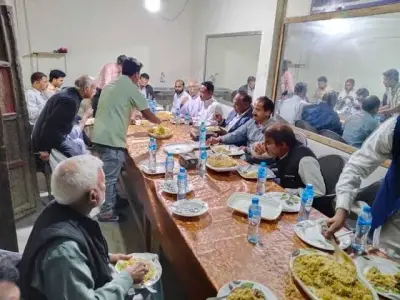
The taziya is a replica of a funeral bier, built because the martyrs of Karbala were denied burial. In Shah Jewna, these structures are assembled by local artisans, many from Sunni and even Wahhabi backgrounds, over nine days. Each taziya stands 25–30 feet tall and weighs 1,200–1,400 kilograms. No one is paid; the work is voluntary devotion. On the ninth of Muharram, Shia mourners focus entirely on rituals, while Sunni volunteers manage logistics, crowd control, medical camps, and distribution of water (Sabils) and food (Niaz). Sunni shoulders carry the taziyas in processions, and Sunni voices recite eulogies.
Defying Sectarian Geography
Shah Jewna lies just 20 miles from Jhang, the birthplace of Haq Nawaz Jhangvi, founder of the anti-Shia militant group Sipah-e-Sahaba. Despite this proximity, sectarian violence never took root in the village. According to local tradition, the love for the Prophet's family transcends sectarian lines, rooted in the teachings of Hazrat Shah Jewna. The village remains poor, with limited education, but its emotional and spiritual maturity allows for shared mourning and protection across sects.
As religious identity becomes increasingly weaponized in Pakistan, Shah Jewna stands as a testament to the power of love over hatred—a tradition preserved for generations, every Muharram.