Israel’s defense minister stated on Tuesday that the United States has endorsed potential Israeli strikes on Beirut’s southern Dahiyeh suburb, a Hezbollah stronghold, if the Iran-backed group attacks northern Israeli communities.
Israel’s New Equation
“The Prime Minister and I led a coordinated move together with the IDF to establish a new equation … If Israeli towns continue to be attacked, we will evacuate and strike the Shiite Dahiyeh quarter in Beirut, Hezbollah’s stronghold,” Israel Katz said at a conference, according to a defense ministry statement. “The United States endorsed this principle and conveyed it to the Lebanese government and all relevant actors … either the fire on Israeli communities stops, or — if fire continues — we will strike in Dahiyeh. This equation will be upheld.”
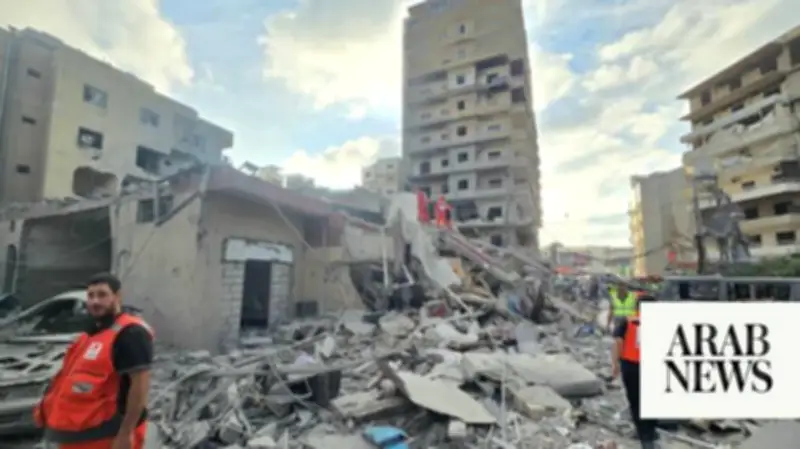
Israel conducted drone strikes on south Lebanon, killing eight people, including two children and their father, while Hezbollah fired into northern Israel on Tuesday. This followed US President Donald Trump’s announcement of an agreement to halt attacks that neither side has publicly accepted.

Ceasefire Violations
According to Lebanese authorities, Hezbollah would cease firing into Israel under the agreement, while the Israeli military would stop striking south Beirut, a long-time bastion of the Iran-backed militant group. The Israeli military on Tuesday warned residents of the southern Lebanese city of Nabatiyeh to evacuate ahead of planned strikes.
“In light of the Hezbollah terrorist organization’s violation of the ceasefire agreement, the IDF is compelled to act against it with force,” the military’s Arabic-language spokesman, Col. Avichay Adraee, posted on X. “For your safety, you must evacuate your homes immediately and move north of the Zahrani River.”
The developments followed a dramatic escalation in violence, with Israeli troops staging their deepest incursion into Lebanon in two decades, conducting heavy bombardment and threatening to strike south Beirut suburbs. As the violence threatened to scupper a ceasefire in the wider Middle East war between the US and Iran, Hadi, a 24-year-old south Beirut resident, told AFP he had hoped for stability, but “that feeling did not last long.”
Trump’s Ceasefire Push
The Israeli military said air defenses intercepted two projectiles that crossed from Lebanon into northern Israel hours after Trump’s announcement. Lebanon’s National News Agency reported fresh Israeli air strikes on south Lebanon on Tuesday. Earlier, Lebanon’s embassy in Washington said Hezbollah had accepted a US proposal for a “mutual cessation of attacks,” though the militant group has not officially confirmed.
“Israel’s strikes on Beirut’s southern suburbs will cease, and in exchange Hezbollah will not attack Israel. And we will work to ensure the ceasefire expands to include all of Lebanon’s territory,” the Lebanese presidency said in a statement. Israeli Prime Minister Benjamin Netanyahu said he told Trump “that if Hezbollah does not cease attacking our towns and our citizens, Israel will strike terrorist targets in Beirut.”
Trump doubled down on his ceasefire push, posting on Truth Social that “hopefully” Israel and Hezbollah would stop fighting “for ETERNITY!” “There will be no Troops going to Beirut, and any Troops that are on their way, have already been turned back,” Trump said after what he described as a “very productive” call with Netanyahu. According to Axios, however, Trump called Netanyahu “f***ing crazy” and accused him of putting Iran peace talks at risk. “Likewise, through highly placed Representatives, I had a very good call with Hezbollah, and they agreed that all shooting will stop — That Israel will not attack them, and they will not attack Israel,” Trump added.
Regional Fallout
Hezbollah drew Lebanon into the Middle East war on March 2 by firing rockets at Israel in retaliation for the killing of Iran’s supreme leader. Tehran has insisted that Lebanon be included in any peace deal with Washington. According to Iran’s Tasnim news agency, Tehran was no longer engaging in talks with Washington due to Israel’s offensive.

The announcements came on the eve of a fourth round of US-hosted direct negotiations between Israel and Lebanon on Tuesday and Wednesday. Military delegations held security talks last week. The threat of new strikes on south Beirut’s suburbs sent people fleeing the densely populated area, causing huge traffic jams linking the area to the capital, AFP images showed.
A truce to halt fighting in Lebanon began on April 17 but has never been observed. Both Israel and Hezbollah accuse each other daily of violating the ceasefire, justifying their attacks by blaming the other for breaches.
Casualties and Peacekeepers
Lebanon’s civil defense agency said Tuesday that six people were killed in an Israeli strike on the south Lebanon village of Marwaniyeh the previous evening. In a Facebook statement, the agency said rescue operations had been ongoing since late Monday at a “residential building that was targeted” near Sidon, resulting in the removal of six bodies and rescue of three wounded people. Israel’s military said two of its soldiers were killed in southern Lebanon, bringing to 27 the number of Israeli military deaths since early March.
Stephane Dujarric, spokesman for UN Secretary-General Antonio Guterres, urged all sides “to respect the cessation of hostilities.” In a report to the UN Security Council, Guterres said it would be necessary to maintain peacekeepers in Lebanon after the current mission’s mandate expires at year-end. France’s Foreign Minister Jean-Noel Barrot said Tuesday that nothing could justify Israeli troops remaining deep inside Lebanon. Israeli troops on Sunday seized the Beaufort castle, which commands sweeping views of south Lebanon. Israeli forces used the castle, also known as Qalaat Al-Chakif, as a base during their previous two-decade occupation of southern Lebanon that ended in 2000.