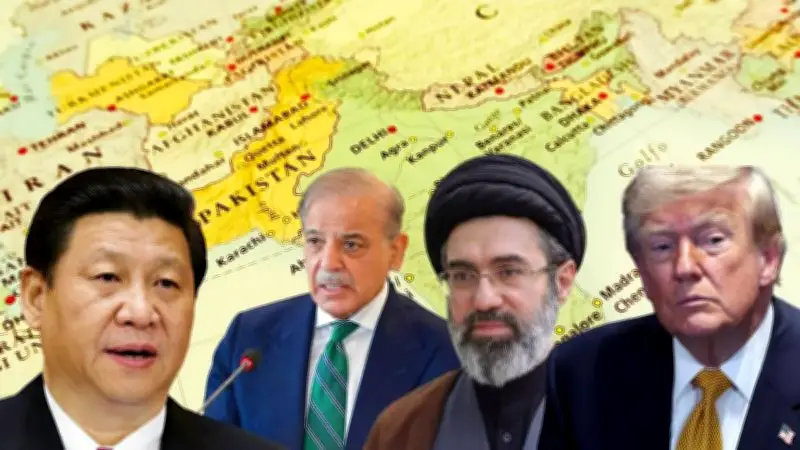
Structural Flaws in the Iran-US Memorandum of Understanding
The breakdown of the Memorandum of Understanding (MoU) between Iran and the United States comes as no surprise. According to Dr. Hasan Zafar, the agreement was structurally designed to fail from the outset. Key unresolved issues, including the status of Gaza and the two-state solution through the establishment of Palestine, remained unaddressed. Israel was conspicuously absent from the framework, raising questions about the viability of any agreement when half of the parties involved in the conflict remained dissatisfied with its contents.
NATO Dynamics and US Pressure on Iran
NATO Secretary General Mark Rutte's support for US action against Iran marks a remarkable development. On 3 July, US intelligence warned Poland of a potential Russian attack and a possible ground invasion from Belarus or Kaliningrad Oblast, a Russian exclave on the Baltic Sea sandwiched between NATO and EU members Poland and Lithuania. At a recent NATO summit in Ankara, former US President Donald Trump also raised the Greenland question, further pressuring NATO members, including Britain and France, which have pledged to send vessels to maintain the southern corridor in the Strait of Hormuz along the Omani coast. Germany has also indicated an intention to join these efforts. These moves by previously reluctant European nations to join the US campaign against Iran ostensibly stem from these two factors.
Turkey and Gulf States' Positions
At the NATO summit, Trump appreciated Turkish President Tayyip Erdoğan for staying out of the Middle East conflict. Trump's agreement to supply F-35 jets and their engines to Turkey could be a reward for Erdoğan's stance. Meanwhile, those speculating about Saudi Arabia leaving the US security umbrella may have forgotten that the Saudi royal family has $1.4 trillion invested in the United States, largely parked in banks controlled by Jewish interests. Smaller Gulf states such as Kuwait, Bahrain and Qatar can scarcely make decisions out of sync with US wishes. Even Oman, previously believed to be leaning towards Iran, allowed the creation of the southern corridor. With these realities, any dreams of a grand Muslim alliance or a Muslim NATO should be reconsidered.

India-Pakistan Tensions and the Threat of War
Dr. Zafar, in a previous article published on 17 June 2026, argued that India would attack Pakistan in 2028. However, new factors may accelerate that timeline. Indian media has been building a narrative against Pakistan for the last two weeks. The focus is on the Indus Waters Treaty and China's support for Pakistan on it. During her recent visit to New Delhi, Japanese Prime Minister Sanae Takaichi echoed the Indian narrative on cross-border terrorism involving Pakistan. Former Singaporean diplomat Bilahari Kausikan criticized Pakistan as a state teetering on the brink of failure. During his visit to Indonesia on 7 July, Indian Prime Minister Narendra Modi and Indonesian President Prabowo Subianto sealed a major defense deal, allowing Jakarta to acquire Indian BrahMos supersonic cruise missiles. Subianto called Modi his favorite man in India. Reports suggest the Philippines will be the next recipient of Indian BrahMos missiles, with the UAE already on the list.
Strategic Importance of the Strait of Malacca and CPEC
The point in focus is the Strait of Malacca, a narrow passage between Indonesia, Singapore and the Philippines. The signal is clear: the target is China's main trade route. The alternative is the China-Pakistan Economic Corridor (CPEC), running through Gilgit-Baltistan, Kashmir, Khyber Pakhtunkhwa and Balochistan—regions of Pakistan all under simultaneous political and military attack. Indian intentions and maneuvers are not hidden. India is openly provoking the Afghan Taliban, the Tehrik-i-Taliban Pakistan (TTP), and the Baloch Liberation Army (BLA), arming them, while its media builds a narrative incessantly. Indian and US interests converge with those of Israel, the UAE, and other regional players who find the Belt and Road Initiative (BRI), CPEC, and a stable, stronger Pakistani economy a threat to their interests.

Iran's Role and China's Dilemma
Iran poses a similar challenge, with substantial Chinese investment in its ports and infrastructure, its access to the Arabian and Caspian Seas, and the Strait of Hormuz. The impression created in Indian and Israeli media that the United States was changing its priorities by distancing itself from key partners was a distraction. It was designed to lure Pakistan and Iran into discussions that would allow Israel and its hexagonal alliance partners to reposition and pressure China by creating a threat around Malacca. The message is clear: stay out of the Iran issue, or face choking through Malacca. However, the real challenge for China is not Malacca but Pakistan, which stands bewildered, split between the Gulf and Iran, and between the United States and China.
Pakistan's Diplomatic Missteps and the Path Forward
Many in Islamabad became excited about peace talks held there, viewing them as a great diplomatic victory. Some imagined a grand Muslim bloc stretching from Turkey to Malaysia. However, many blocks from this castle have already fallen over the past few weeks. China's problems, and Pakistan's own, will begin to solve themselves once clarity dawns upon Islamabad. The sooner it embraces reality and its real allies, the better. The crisis may be even closer than currently imagined.