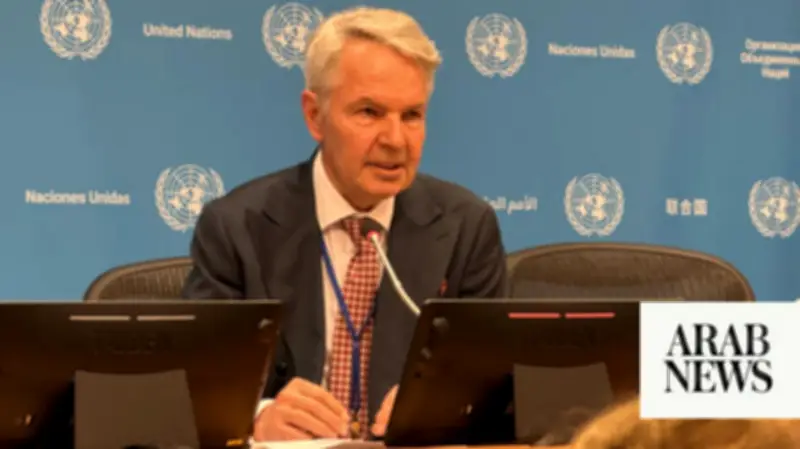
The 2023 Jeddah agreement brokered by Saudi Arabia can still serve as a foundation for future Sudan peace talks, the UN’s special envoy for Sudan, Pekka Haavisto, said on Thursday, even as he voiced alarm over an intensifying offensive by the Rapid Support Forces (RSF) around the city of El-Obeid.
Haavisto Coordinates With Peace Initiatives
Haavisto told reporters at the UN headquarters in New York that he was coordinating with about 10 nongovernmental peace initiatives, including the Carter Center and the Centre for Humanitarian Dialogue, to avoid any “forum shopping” by the warring parties, which he said sometimes play mediators off against one another by choosing who to engage with.
Alarm Over El-Obeid
Regarding the situation in El-Obeid, Haavisto said he was “alarmed” by escalating hostilities around the city, and warned that any further deterioration could put thousands of civilians at risk and echo the devastation previously seen in Darfur and El-Fasher. He said frequent drone strikes and the massing of troops around the city were already disrupting the flow of humanitarian aid, with UN agencies active on the ground reporting signs of a possible isolation or siege.

UN Leaders Sound Alarm
The UN secretary-general, Antonio Guterres, and the high commissioner for human rights, Volker Turk, have each sounded the alarm over reports of a significant buildup of RSF troops around El-Obeid, the capital of North Kordofan state, amid intensified drone strikes and artillery shelling over the past two weeks. “We have seen this playbook before,” Turk said as he warned that there must be no repeat of the atrocities documented in El-Fasher and the Zamzam displacement camp in North Darfur last year.
Haavisto’s Call With Hemedti
Haavisto said that during a telephone conversation last Friday he told the leader of the RSF, Gen. Mohammed Hamdan Dagalo, commonly known as Hemedti, that “all the eyes of the world are now on El-Obeid.” Hemedti assured him he did not intend to harm civilians and would protect humanitarian corridors into the city. But Haavisto cautioned that “nothing can be said as a very sure issue” when it comes to the conflict in Sudan.
Security Council Demands Halt
The Security Council demanded over the weekend that the RSF, which has been locked in a civil war with the Sudanese Armed Forces since April 2023, immediately halt its assault on El-Obeid, warning of the imminent risk of mass atrocities. Haavisto said he would be tracking developments closely in the coming days. He also voiced concern over the rising use of drones in the broader conflict, including strikes on civilians and civilian infrastructure, and urged the international community to examine ways to curb access to the technology, which he said was sourced from the global market.
Political Track Progress
On the political track, the so-called “quintet” of organizations — the UN, the African Union, the Intergovernmental Authority on Development, the League of Arab States and the EU — have convened the first meetings in three years between Sudanese political parties and civil society, firstly in Berlin in April and then in early June in Addis Ababa. Haavisto said he plans to travel to Kenya for talks next week, and to engage further with Chad, South Sudan and Uganda over the summer.
Quad Group and Humanitarian Truce
He said he hopes the “Quad” group of nations — the US, Saudi Arabia, the UAE and Egypt — can advance efforts to agree a humanitarian truce that would ease civilian suffering and help create space for a political settlement. Haavisto said he had just come from Washington where he had “a good discussion” with US envoy Massad Boulos, with whom close coordination will continue.

Obstacles to Peace
Asked about the prospects for an end to the war in Sudan, Haavisto said the principal obstacle to peace is the fact that both Hemedti and the leader of the Sudanese Armed Forces, Gen. Abdel Fattah Al-Burhan, still believe they can achieve gains militarily. The war leaders are also influenced by allied political and armed factions, he added, which complicates efforts to reach a deal. However, countries with influence over the warring parties — including Saudi Arabia, the UAE and Qatar, which he visited recently — no longer believe a military solution is achievable, Haavisto said.
Unresolved Post-Conflict Questions
Regarding the possibility of a humanitarian truce, he said the unresolved question of “the day after” the conflict ends — including administrative boundaries, a potential parallel government and the shape of a transitional period — has held back previous efforts to achieve this. The quintet, in particular the work of the African Union and Arab League, might be better positioned to offer answers to this question, he added.
Dealing With RSF and Hope for Reconciliation
Asked by Arab News how efforts to deal with the RSF have changed over time, given its history of atrocities dating to the Janjaweed era, Haavisto said that there was “sometimes very little hope in Sudan, because of the history of the fighting.” There are about 100 to 140 militias in the country, he explained, which represent a complex “mosaic” and “the leaders of these groups have to have a certain responsibility.” He added: “We have to appeal to these people that they have to follow the norms of warfare.” The rules of international law apply and the UN is monitoring the conduct of the groups, he noted.
Haavisto told Arab News that what gives him hope is what he saw and heard during meetings in Port Sudan, Cairo and Nairobi with groups of women who had fled the conflict. “The first sentence is that they will never forgive what has happened,” he said, but “the next sentence already is that there has to be some kind of reconciliation process” modeled on the experience in South Africa.
No Division of Sudan
Asked whether the Quad had discussed the possibility of dividing Sudan, or some power-sharing deal between the two sides, Haavisto said any division of the country or long-term arrangement with parallel governments and two armies was “impossible to think about,” and the position of the UN remained that a unified, sovereign Sudan must be secured through a Sudanese-led process. He noted that reconstruction work had begun in Omdurman, near Khartoum, where residents were reopening shops and restaurants, describing this as a rare note of optimism in the conflict.