North Korea Conducts Second Cluster Bomb Missile Test This Month
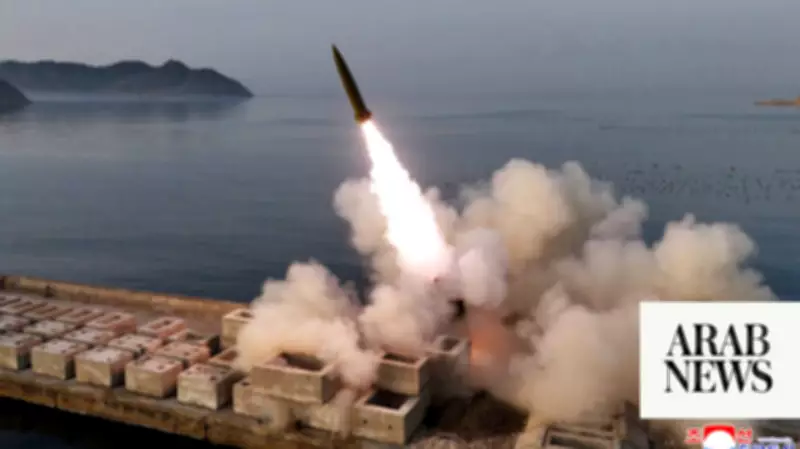
North Korea announced on Monday that it successfully test-launched ballistic missiles equipped with cluster bomb warheads, marking the second such demonstration of this advanced weaponry within the current month. This latest test, which took place on Sunday, was closely monitored by North Korean leader Kim Jong Un and his teenage daughter, Kim Ju Ae, from a coastal observation point.
Details of the Missile Launch and Strategic Implications
The launch involved five upgraded surface-to-surface Hwasong-11 Ra ballistic missiles, which were armed with both cluster bomb warheads and fragmentation mine warheads. According to the official Korean Central News Agency (KCNA), these missiles accurately struck an island target, prompting Kim Jong Un to express his satisfaction with the results. He emphasized the military significance of enhancing the country's high-density striking capability, a statement that underscores North Korea's ongoing efforts to bolster its offensive arsenal.
This test follows a similar launch earlier in the month, where North Korea tested Hwasong-11 Ka ballistic missiles with cluster bomb warheads, claiming they could devastate areas spanning 6.5 to 7 hectares. The consistent focus on cluster munitions highlights a strategic push to develop weapons capable of penetrating the advanced missile defenses of the United States and South Korea.

International Context and Observers' Analysis
Observers suggest that the ongoing conflict in Iran may have influenced North Korea's decision to publicly showcase its cluster munitions capabilities. The destructiveness of these weapons, which release multiple bomblets over a wide area, has been a point of contention in recent conflicts, including accusations against Iran for using similar tactics to challenge air defenses.
It is important to note that while over 120 countries have signed an international treaty banning the use of cluster munitions, North Korea, along with Iran, Israel, and the United States, remains outside this agreement. This positions North Korea's tests within a broader geopolitical landscape where such weapons are still considered viable tools of warfare.
Kim Jong Un's Daughter and Succession Speculations
The presence of Kim Jong Un's daughter, Kim Ju Ae, at the missile test has fueled speculation about her potential role in the regime's future. Recent assessments by South Korea's intelligence services indicate that she could be considered a possible heir to her father, adding a dynastic element to North Korea's military and political strategies.
Broader Military Ambitions and Diplomatic Maneuvers
Since the collapse of nuclear diplomacy with former U.S. President Donald Trump in 2019, North Korea has aggressively pursued the expansion of its nuclear arsenal and the development of high-tech weapons. This includes multi-warhead nuclear missiles, hypersonic weapons, and submarine-launched ballistic missiles, all designed to enhance its ability to counter U.S. and South Korean defenses.
Despite the heightened military activities, diplomatic channels remain a possibility. Kim Jong Un has recently indicated openness to dialogue with Trump, though he insists that Washington must drop its demands for North Korea's nuclear disarmament as a precondition. With Trump scheduled to visit Beijing for a summit with Chinese President Xi Jinping in May, some analysts believe North Korea's recent tests are aimed at increasing its leverage in potential future negotiations with the United States.
In summary, North Korea's latest missile test not only demonstrates its advancing military capabilities but also serves as a strategic message to the international community, particularly as diplomatic opportunities may arise in the coming months.