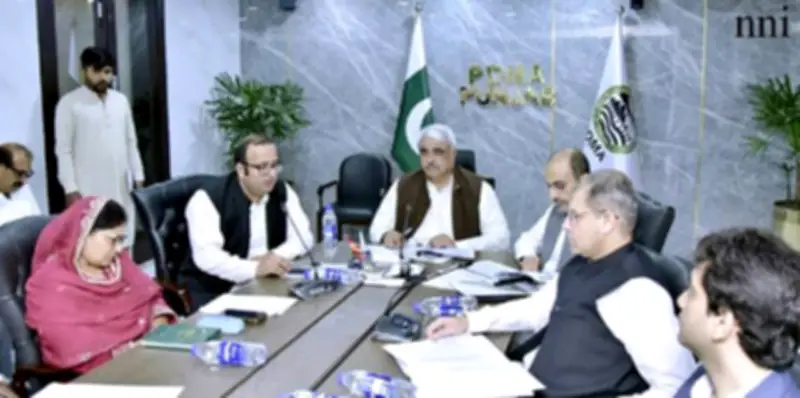
Punjab's Cabinet Committee on Disaster Management convened on Saturday to assess the province's readiness for the ongoing monsoon season and potential flood scenarios. The meeting, held at the Provincial Disaster Management Authority (PDMA) headquarters in Lahore, was chaired by Provincial Health Minister and Committee Chairman Khawaja Salman Rafique. Attendees included Senior Member Board of Revenue Nabeel Javed, PDMA Director General Umer Kavaid, and senior officials, with commissioners and deputy commissioners from various divisions and districts participating via video link.
Briefing on Monsoon and Flood Preparedness
The committee received detailed briefings on monsoon preparedness, heatwave response measures, and flood management strategies. Officials reported that all necessary arrangements had been finalized to address heatwave conditions and strengthen both pre-disaster and post-disaster response mechanisms. The briefing covered the current status of emergency equipment, coordination protocols, and resource deployment plans across vulnerable districts.
Removal of Encroachments to Reduce Flood Risks
Khawaja Salman Rafique emphasized that encroachments along riverbeds and hill torrent channels were being systematically removed to minimize flood risks. He stated that the Punjab government, under Chief Minister Maryam Nawaz's vision, was implementing comprehensive measures to enhance the province's flood resilience. Rafique highlighted that Rescue 1122 had been equipped with modern emergency response equipment worth billions of rupees to improve overall disaster response capacity.

Review of 11 Flood Protection Schemes
The committee reviewed 11 flood protection schemes designed to prevent river erosion and safeguard vulnerable settlements and agricultural land. These schemes are being implemented in districts including Sarai Alamgir, Kharian, Gujrat, Attock, and Sheikhupura, as well as areas along the Jhelum, Indus, and Ravi rivers. Officials discussed the progress and effectiveness of these projects in mitigating flood damage.
Updated Floodplain Boundaries and Flood Hazard Atlas
Officials also discussed the proposed notification of updated floodplain boundaries based on the 2025 floods, aiming to improve land-use planning and risk management. The committee reviewed the Flood Hazard Atlas for vulnerable districts, which provides detailed mapping of flood-prone areas. Additionally, they assessed relief operations, challenges, and future planning derived from the 2025 floods in Multan division, incorporating lessons learned into current strategies.
Water Pipeline Projects in Cholistan
The meeting was informed that water pipelines were being laid in remote areas of Cholistan at a cost of millions of rupees to improve access to drinking water. This initiative is part of broader efforts to address water scarcity in arid regions and enhance community resilience against climate-related stresses.