On a warm summer afternoon in Manhattan, four old high school friends gathered for lunch at The Smith in Midtown East. The years had scattered us across continents and careers, but somehow the familiar rhythm of friendship returned within minutes. We had all done reasonably well for ourselves. Three of us had spent decades in finance, navigating markets from New York to Zurich and Dubai. The fourth had taken a different route, becoming a professor and public intellectual whose interests straddled economics, politics, and history.
The conversation began predictably enough. Families, careers, ageing parents, health, and the inevitable jokes about receding hairlines and expanding waistlines occupied the opening minutes. But like so many reunions among people who have known each other since adolescence, nostalgia soon gave way to bigger questions. Outside, Manhattan hummed with its usual confidence and energy. Inside, over grilled fish, salads, and coffee, we found ourselves discussing the state of the world. Markets were volatile, geopolitics seemed increasingly unstable, democracies were under strain, and international conflicts appeared to multiply by the day.
Inevitably, the discussion drifted toward Pakistan. One friend, a veteran Wall Street banker, shook his head while discussing Pakistan's recurring political and economic crises. “You know,” he said, “when I read the headlines these days, the phrase that comes to mind is ‘saanu ki.’” The table erupted in laughter because every Punjabi immediately understood what he meant. The phrase literally translates as “What is it to us?” but its true meaning is closer to “Why should we care?” or “It's not our problem.” Another friend immediately added its equally familiar companion phrase, “mitti pao,” prompting even more laughter. Literally meaning “put dirt on it,” it conveys the idea of letting something go, forgetting about it, and moving on.

From Humor to Reflection
For a few moments, these expressions were simply a source of humour and nostalgia. We recalled hearing them from parents, grandparents, neighbours, shopkeepers, and relatives throughout our childhoods. They were woven into the everyday language of Punjabi life and carried a certain earthy wisdom. Yet as often happens among old friends, what began as lighthearted banter gradually evolved into something more thoughtful. The professor among us leaned forward and posed a question that instantly changed the tone of the conversation. He asked whether these phrases were more than mere expressions and whether they reflected something deeper about our political culture. The question lingered in the air because, suddenly, we realised that we were no longer discussing language. We were discussing society.
Of course, no nation can be explained by a couple of sayings. Pakistan's challenges are rooted in a complex mixture of history, institutions, colonial legacies, geopolitical realities, military interventions, economic structures, educational shortcomings, and governance failures. No serious observer would reduce such complexities to a handful of cultural expressions. Yet culture matters too. Ideas matter. The stories societies tell themselves matter. The habits of mind that people inherit and pass on across generations matter.
Perhaps these two seemingly harmless phrases reveal something important. “Saanu ki” encourages disengagement, while “mitti pao” encourages acceptance. In personal life, both attitudes possess considerable wisdom. Life becomes unbearable if one obsesses over every grievance or becomes emotionally invested in every dispute. There is maturity in knowing when to let go and wisdom in recognising that some battles are simply not worth fighting for. The problem arises when these attitudes migrate from personal life into public life. What happens when corruption is met with a collective shrug? What happens when violations of the rule of law are greeted with indifference? What happens when institutional decay becomes something people simply learn to tolerate? In such circumstances, these expressions cease to represent resilience and begin to resemble resignation.

Comparative Perspectives on Civic Engagement
As our lunch continued, we found ourselves comparing societies and historical experiences. The great democratic reforms of history rarely emerged from populations that collectively decided that problems belonged to someone else. Civil rights movements succeeded because individuals insisted that another person's suffering was also their concern. Labour protections were achieved because workers refused to accept existing conditions as permanent. Women's rights expanded because people challenged prevailing norms rather than quietly accommodating them. Environmental reforms emerged because citizens demanded change rather than accepting decline. In almost every case, progress began when ordinary people rejected the logic of “saanu ki.” They chose engagement over indifference and participation over passivity.
One friend pointed out that many successful societies actively cultivate this instinct. Citizens attend local meetings, organise community groups, volunteer for causes, write letters to elected officials, support civic organisations, and participate in public debates. They do not necessarily do these things because they expect immediate success. Rather, they do them because they believe that public life belongs to them and that citizenship entails responsibilities as well as rights.
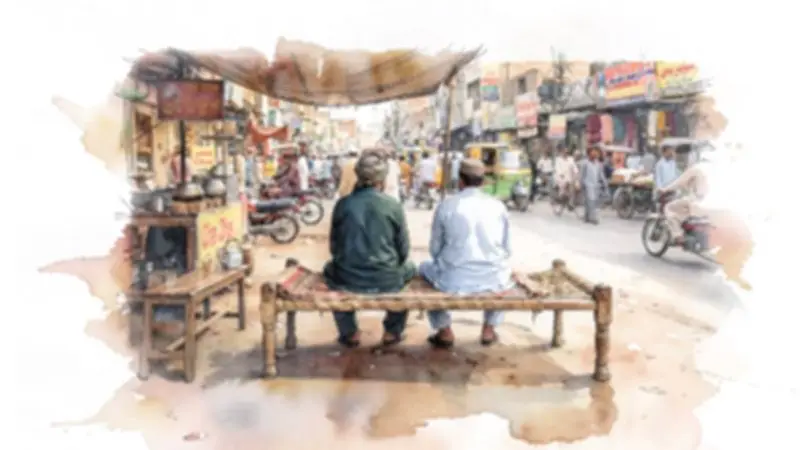
The professor then offered an observation that stayed with me long after the lunch ended. He noted that the opposite of activism is not extremism or simply turning towards religion; the opposite of activism is indifference. That distinction seemed particularly important because Pakistan often suffers from a curious paradox. The country is overflowing with political discussion. Tea stalls buzz with analysis. Social media platforms overflow with opinions. Television talk shows dominate the airwaves. Political gossip travels at astonishing speed. Yet discussion does not always translate into civic action. Many citizens have become spectators of politics rather than participants in it. They observe, complain, analyse, debate, and criticise, but often stop short of sustained engagement. Too frequently, the final response becomes some variation of “what can one do?” or “why get involved?” The spirit of “saanu ki” quietly returns.
The Punjab Paradox
This phenomenon may be especially visible in Punjab, the country's largest and most politically influential province. Punjab has produced extraordinary entrepreneurs, professionals, soldiers, artists, academics, philanthropists, and public servants. Punjabis are rightly known for their energy, ambition, industriousness, and optimism. Yet politically there has often been a tendency to favour stability over confrontation, accommodation over agitation, and pragmatism over activism. These characteristics are not inherently negative. Indeed, they have frequently contributed to economic success and social cohesion. However, every cultural strength contains a potential weakness. The same pragmatism that helps individuals succeed can sometimes discourage collective action. The same desire for stability can sometimes permit unhealthy systems to endure. The same instinct to move forward can sometimes weaken the demand for accountability.
As the conversation deepened, we began discussing our experiences as immigrants. Most of us had spent decades living abroad. We had observed societies where ordinary citizens routinely challenge authority, organise politically, advocate for causes, and hold institutions accountable. We had witnessed communities mobilise around schools, transportation systems, environmental concerns, public services, and local governance. In many of these places, civic engagement was not considered extraordinary; it was considered normal. Yet as we reflected on these societies, we also recognised traces of our own upbringing. How often had we ourselves responded to troubling developments with a sense of resignation? How often had we adapted to circumstances rather than confronting them? How often had we privately concluded that meaningful change was unlikely?
Perhaps these tendencies are not uniquely Punjabi or Pakistani. Every society possesses its own vocabulary of resignation. The British are often associated with stoicism. Russians have frequently been described as possessing a deep sense of fatalism. Many cultures in the Middle East invoke destiny to explain events beyond their control. Americans, despite their activism, can sometimes retreat into individual success and private concerns. No society enjoys a monopoly on passivity.
Cultural Habits and Institutional Outcomes
Nevertheless, cultural habits matter because they shape expectations, and expectations shape institutions. If citizens expect little from public institutions, institutions often deliver little. If poor governance is routinely tolerated, poor governance tends to persist. If accountability is rarely demanded, accountability rarely materialises. Over time, power becomes increasingly insulated from scrutiny and reform becomes more difficult.
As our plates were cleared and the lunch drew to a close, I found myself reflecting on the contrast between our surroundings and our conversation. We were sitting in one of the world's most dynamic cities, a place built by generations of immigrants, reformers, entrepreneurs, activists, and citizens who believed that public life was worth shaping. New York's history is filled with people who refused to accept existing realities as permanent and who insisted that change was possible.
Perhaps that is the deeper lesson. Societies improve not because they avoid problems but because enough people decide that those problems belong to them. The opposite of “saanu ki” is not anger, it is ownership. The opposite of “mitti pao” is not bitterness, it is accountability. A healthy society requires both the wisdom to let go of what cannot be changed and the courage to confront what must be changed.
Pakistan's future will ultimately depend on many factors, including stronger institutions, better leadership and governance, serious economic reforms, educational improvements, constitutional stability, and the rule of law. Yet beneath all of these lies something more fundamental: the mindset of its citizens. Nations begin to change when people stop asking, “What is it to me?” and start recognising that public problems are shared responsibilities.
As we stepped out into the bright Manhattan afternoon and headed our separate ways, I could not help smiling at the irony. A casual Punjabi phrase, uttered between old friends over lunch, had evolved into a meditation on citizenship, responsibility, culture, and national renewal. What began as nostalgia had become a serious reflection on the choices societies make and the attitudes they cultivate.
Perhaps Pakistan's future depends, at least in part, on replacing two familiar expressions with a different sentiment altogether—that of a collective recognition that the fate of a nation belongs to all of its citizens and that meaningful progress begins when people decide that they care.