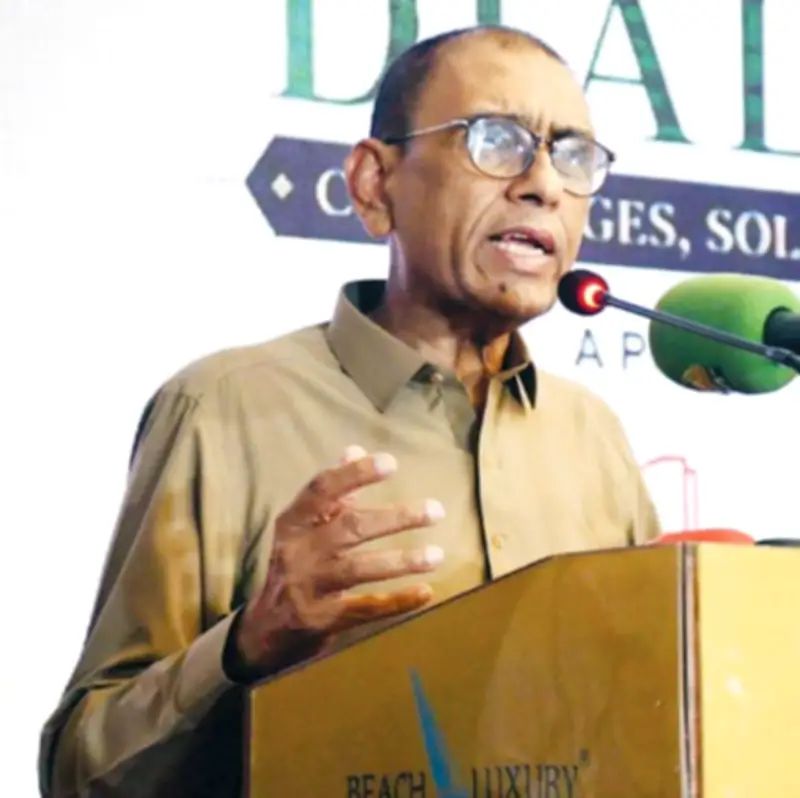
KARACHI – Speakers at a dialogue organized by Muttahida Qaumi Movement-Pakistan (MQM-P) on Sunday argued that Karachi’s longstanding problems could only be resolved through an empowered local government system, implementation of Article 140-A of the Constitution, and the creation of new administrative provinces. The event, titled The Dialogue Karachi, was held at a local hotel and brought together politicians, former bureaucrats, economists, journalists, and business leaders to discuss the city’s governance, economic challenges, public services, and urban development issues.
MQM-P Chairman Defends Party’s Legacy
Addressing the gathering, MQM-P Chairman Dr. Khalid Maqbool Siddiqui defended the party’s political legacy and claimed that much of Karachi’s development was achieved during MQM’s tenure in local government. “Whatever development is visible in Karachi today is largely the result of MQM’s efforts,” he said, adding that the city’s first mass transit project was approved during the party’s local government administration. Dr. Siddiqui said allegations linking MQM to incidents ranging from the killings of Hakim Saeed and Amjad Sabri to the Baldia factory tragedy and weapons recoveries had not been proven in courts. He maintained that MQM had faced imprisonment and political persecution for raising its voice on urban issues.
Demand for New Province
The MQM-P chief also reiterated his party’s demand for a new province comprising urban areas, saying it was a constitutional requirement and a practical necessity. He questioned the utilization of funds received by Sindh under the 18th Constitutional Amendment and criticized what he described as the concentration of powers at the provincial level.

Speakers Highlight Civic Challenges
MQM leader Javed Hanif said Karachi was being administered by people disconnected from the city and argued that solutions to its problems existed but lacked political will. He stressed the importance of an accurate population census as a prerequisite for ensuring the city received its due share of resources and representation. MNA Sabeen Ghauri said Karachi remained home to people of all ethnicities, religions, and backgrounds but was burdened with mounting civic challenges. She called for the implementation of Article 140-A, which mandates the devolution of powers to elected local governments.
Former Governor’s Perspective
Former Sindh governor Moinuddin Haider said rapid urbanization and population growth in Karachi had not been matched by adequate representation and resources. He argued that the quota system had contributed to the emergence of MQM and said the creation of new provinces had become unavoidable. Haider criticized the impact of the 18th Amendment, saying it had strengthened provincial governments without effectively transferring powers to the grassroots level.
Analysts and Experts Weigh In
Senior analyst Mazhar Abbas expressed concern over Karachi’s deteriorating civic and cultural conditions, saying the city’s education sector, public services, and local government institutions had suffered sustained decline. “Local bodies serve as the nursery of democracy, but democratic institutions have been weakened in the country,” he said, adding that Karachi had become trapped in the influence of powerful mafias and vested interests. Journalist Amir Zia described it as unfortunate that Karachi, despite being Pakistan’s economic hub, continued to rank among the world’s least livable cities. He argued that Karachi’s issues were not ethnic in nature but national in significance.
Business Community Voices Concerns
Businessman Sohail Wajahat Siddiqui criticized governance and accountability mechanisms in the city, while former federal law minister Barrister Shahida Jamil highlighted corruption, poor infrastructure, waste management failures, and a deteriorating sewerage system as major concerns. Builder and business community representative Muhammad Hassan Bakhshi lamented what he described as official neglect of Karachi despite its central contribution to the national economy.

Call for Local Autonomy
Dr. Asim Bashir cited Istanbul’s municipal governance model and advocated greater local autonomy for Karachi, including authority over urban planning and development. He also called for reforms to ensure the effective implementation of Article 140-A.
Consensus on Way Forward
At the conclusion of the event, participants agreed that Karachi’s survival and future development depended on empowering local leadership through financial and administrative autonomy, meaningful implementation of constitutional provisions governing local government, and the establishment of new administrative provinces.