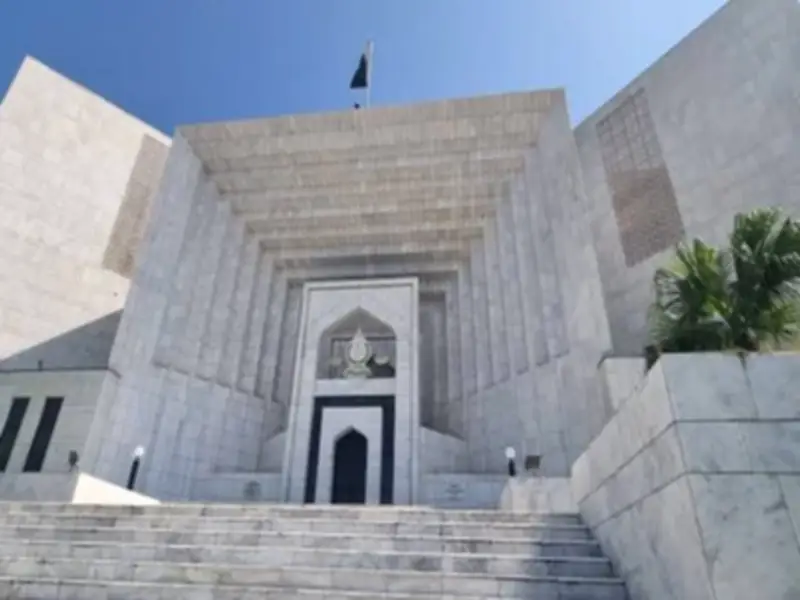
The Supreme Court of Pakistan has delivered a significant judgment clarifying the mandatory requirements for filing a pre-emption suit. In a case titled Sherzali and Others vs Saadullah Khan, a three-member bench comprising Justice Muhammad Ali Mazhar, Justice Musarrat Hilali, and Justice Shahid Bilal Hassan ruled that the date, time, and place of Talb-e-Muwathibat (immediate demand) must be specifically pleaded and proved. Failure to fulfill this legal requirement is fatal to the claim.
Case Background
The dispute originated from the transfer of six kanals and eight marlas of land in Kohat. Saadullah Khan filed a pre-emption suit, asserting that upon learning of the property sale, he immediately exercised Talb-e-Muwathibat and later completed the formalities of Talb-e-Ishhad (demand with witnesses). However, the trial court dismissed the suit on the grounds that the plaint did not specify the date and place where Talb-e-Muwathibat was allegedly made.
Appellate and High Court Decisions
The appellate court and the Peshawar High Court (PHC) overturned the trial court's decision, ruling in favor of the plaintiff. Dissatisfied, the defendants appealed to the Supreme Court, which set aside the judgments of the appellate court and the PHC, restoring the trial court's dismissal of the suit.

Supreme Court's Observations
In its detailed judgment authored by Justice Shahid Bilal Hassan, the apex court observed that the right of pre-emption is a weak and delicate right that can only be enforced through strict compliance with all statutory requirements. The court emphasized that Talb-e-Muwathibat constitutes the very foundation of a pre-emption claim, making it essential for a claimant to clearly plead and prove the time, date, and place at which the demand was made.
The bench held that where this fundamental requirement is absent, all subsequent proceedings lose their legal efficacy. Referring to a number of judicial precedents, the Supreme Court ruled that omission of the mandatory particulars of Talb-e-Muwathibat in the plaint amounts to a fatal defect, which cannot be cured by evidence produced at a later stage.
Impact of the Ruling
The Supreme Court further noted that the plaintiff had also failed to establish the complete chain of information regarding the sale. This judgment reinforces the strict procedural requirements for pre-emption claims under Islamic law and Pakistani jurisprudence. Legal experts say the ruling will deter frivolous pre-emption suits and ensure that claimants provide precise details at the outset.
According to the judgment, the right of pre-emption is not a strong right but a weak one, and the burden of proof lies heavily on the plaintiff to demonstrate strict compliance with the law. The decision is expected to guide lower courts in handling similar cases.