Climate Displacement in Pakistan: From Temporary Evacuation to Permanent Migration
In a crowded settlement on the outskirts of Quetta, 42-year-old Abdul Samad still keeps the rusted key to the mud house he left behind during Pakistan’s devastating 2022 floods. The key hangs from a nail inside the single rented room where his family now lives. He says he carries it as a reminder that one day he may return home, although deep down he is no longer sure that home still exists in the way he remembers it.
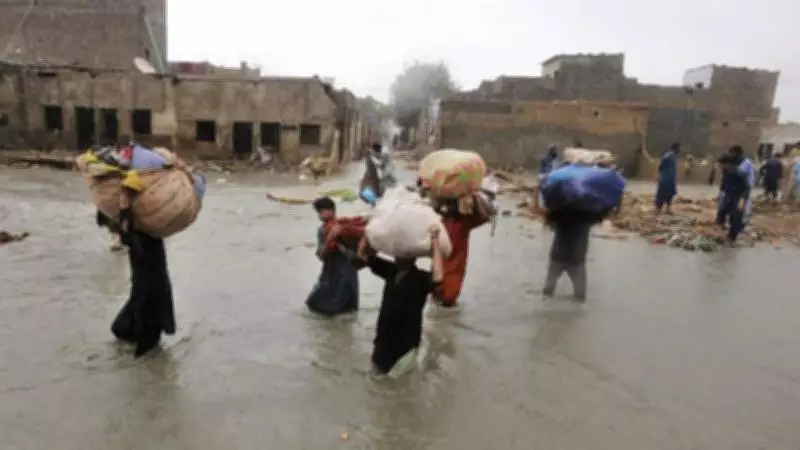
Samad’s village in Jaffarabad district, southeastern Balochistan, was submerged after days of heavy rains and overflowing rivers destroyed homes, roads, and farmland. Nearly four years later, much of the area still struggles with damaged irrigation systems, broken roads, and shrinking agricultural activity. Layers of dried mud and sand cover parts of the farmland that once supported entire families.
“When we first arrived in Quetta, we thought it would only be for a few weeks,” Samad said quietly. “But then another season came, and there was no recovery. Then prices increased, jobs disappeared, and we realized we could not go back.”

Samad is among thousands of Pakistanis whose displacement, initially described as temporary, is slowly becoming permanent. Across Pakistan, especially in Balochistan and Sindh, climate disasters are reshaping migration patterns and pushing vulnerable families away from villages toward overcrowded urban centres. Unlike refugees crossing international borders, these migrants rarely appear in global discussions about climate displacement. Most move quietly from rural communities to cities such as Quetta, Karachi, Hub, and Gwadar. Some live with relatives, while others rent small rooms in low-income neighborhoods or build temporary shelters on unused land near industrial areas. Their stories remain largely undocumented, but together they reflect a major transformation taking place across Pakistan. Climate change is not only damaging homes and crops. It is also slowly changing where people live, work, and build their futures.
Why The West Needs Migrants But Hates Them | Dr. Rasul Bukhsh Rais
Pakistan’s 2022 floods were among the worst climate disasters in the country’s history. Government estimates showed that more than 33 million people were affected. Heavy monsoon rains combined with glacier melt in northern regions caused rivers to overflow and entire villages to disappear under water. The floods destroyed homes, schools, hospitals, roads, crops, and livestock across large parts of Sindh, Balochistan, and southern Punjab. In Balochistan, districts such as Jaffarabad, Sohbatpur, Naseerabad, Lasbela, and Qila Saifullah suffered widespread destruction. Many roads remained damaged for months, limiting access to aid and delaying reconstruction efforts.
For many families, however, the floods were not an isolated disaster. Before the floods came years of drought, water shortages, and extreme heat. After the floods came inflation, crop losses, and unemployment. Climate stress became continuous rather than temporary. Climate researchers say this repeated cycle of disasters is changing how people make decisions about migration. In the past, families often moved temporarily during difficult periods and later returned home once conditions improved. Today, many no longer believe recovery is possible.
In Quetta’s informal settlements, new arrivals continue to appear years after the floods faded from international headlines. Many displaced men now work as daily wage labourers at construction sites, markets, or workshops. Some collect recyclable waste or push vegetable carts through crowded streets. Women often take home-based work such as embroidery, stitching, or domestic labour. Most migrants say they never intended to settle permanently in cities. But returning home requires money, stable livelihoods, functioning infrastructure, and some confidence that another disaster will not destroy everything again. For many families, those conditions no longer exist.
In Hub, the industrial town linking Balochistan with Karachi, flood-affected families now live in densely populated neighborhoods near factories and warehouses. Some migrated after losing farmland in Sindh and Balochistan. Others arrived after recurring droughts destroyed livestock and weakened agriculture-based livelihoods.

Home Away From Home: Remembering London’s Pakistan Students' Hostel
Urban migration itself is not new in Pakistan. People have long moved to cities seeking education, employment, or better services. But climate-linked migration is adding pressure to cities already struggling with overcrowding, housing shortages, weak infrastructure, and water scarcity. Urban planners warn that Pakistan still lacks long-term planning for climate-driven internal migration. Most displaced families receive emergency support during disasters, such as tents or food assistance, but little attention is given to long-term settlement, employment, healthcare, or education after the emergency phase ends. As a result, many displaced families become trapped in cycles of poverty inside cities. Informal settlements continue expanding without proper sanitation, drainage systems, or stable electricity. In some neighborhoods, several families share a single room because rent prices continue to rise.
For many migrants, displacement is not only economic. It is also deeply emotional. In rural Balochistan and Sindh, identity is closely connected to land, farming, livestock, and extended family networks. Migration disrupts these social structures. Thirty-year-old Shazia Bibi moved from Sohbatpur to Karachi after floodwaters destroyed her village. Her husband now works long hours at a fish market while she stitches clothes inside a small rented room shared by eight family members. “In the village, everyone knew each other,” she said. “Here life is different. Everything costs money. Even water costs money.” Her children no longer attend school regularly because the family struggles to pay transportation and school expenses.
Aid workers and education activists say many displaced children, especially girls, never fully returned to education after the floods. Economic pressure has also increased child labour and early marriages in some displaced communities. Community workers say women often face additional burdens after migration, balancing household responsibilities with income generation in unfamiliar urban environments.
Pakistan’s Crisis Cycle: Why Reform Never Comes
Mental health impacts remain largely invisible. Local organizations working with displaced communities report rising stress, anxiety, and uncertainty among families who continue living in temporary conditions years after the disaster.
Yet climate migration is not always only a story of loss. For some families, mobility becomes a form of adaptation and survival. Younger people increasingly migrate to cities because traditional livelihoods such as farming and livestock rearing are becoming less reliable under changing climate conditions. In drought-affected parts of Balochistan, some young men now move seasonally between villages and cities searching for work. Others seek opportunities in Gulf countries or industrial zones. Migration in many cases becomes a strategy to reduce climate-related risks. Researchers studying climate mobility in South Asia say it is important not to portray migrants only as helpless victims. Many families show resilience and agency despite difficult circumstances. Some communities build informal support networks in cities, sharing housing, employment information, and financial support. Still, adaptation depends heavily on resources. Families with education, savings, or relatives in urban areas often adjust more easily. Poorer families face greater risks of exploitation, unsafe housing, debt, and unstable work.
While Sindh’s flood devastation received widespread international attention in 2022, many stories from Balochistan remained underreported. Journalists and researchers say remote geography, limited infrastructure, and weak media access reduce coverage from many parts of the province. Yet Balochistan faces some of Pakistan’s most severe climate vulnerabilities. The province regularly experiences droughts, flash floods, water shortages, and extreme heat. Agricultural communities already struggling with poverty face repeated environmental shocks with limited state support. In some flood-affected villages, reconstruction remains incomplete years later. Farmers report damaged irrigation systems, reduced crop production, and difficulty accessing compensation. Several displaced families say they received emergency assistance initially but little long-term support afterward.
Pakistan’s Education Debt: A Nation That Has Never Paid What It Owes Its Children
Climate experts warn that migration linked to environmental pressures is likely to increase across South Asia in coming decades. According to World Bank projections, millions of people across the region could be forced to move internally by 2050 due to water scarcity, crop failures, heatwaves, and natural disasters. Pakistan contributes relatively little to global carbon emissions, yet it remains among the countries most vulnerable to climate change. Rapid urbanization combined with climate stress is creating difficult challenges for cities already struggling to provide housing, water, transport, and healthcare. The situation becomes even more complex because many urban areas are themselves climate-vulnerable. Karachi faces heatwaves, flooding, and rising sea levels. Quetta struggles with groundwater depletion and water shortages. Gwadar’s coastal communities are increasingly exposed to changing weather patterns and water stress.
These realities raise important questions about the future. If climate disasters continue damaging rural livelihoods, can Pakistan’s cities absorb large-scale migration in a sustainable way? And what happens when the cities themselves become vulnerable to climate shocks?
Back in Quetta, Abdul Samad still speaks about his village with deep attachment. He remembers the evenings, the farmland, and the sense of community that shaped his life before the floods. But rebuilding requires resources his family no longer have. Rent, food prices, and unstable work consume most of their income. His children are slowly adapting to city life even though they still ask questions about the village they left behind.
For many climate-displaced families across Pakistan, life now exists somewhere between return and permanent resettlement. Their migration was supposed to be temporary. Instead, climate disasters may be quietly creating a new generation of permanent urban migrants—families forced to rebuild their lives far from the homes they once expected to return to.