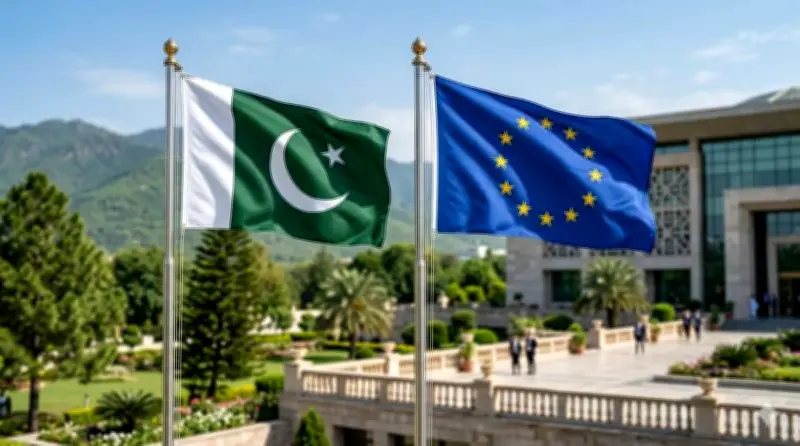
Diplomatic language is never accidental. In joint formulations, every word, sequence, and absence conveys a political message. The paragraph in the joint communiqué from the European Union and Pakistan following Kaja Kallas' visit to Islamabad warrants serious attention. The communiqué, issued after the 8th Pakistan–EU Strategic Dialogue on 1 June 2026, stated: “The Pakistan side briefed on the issue of Jammu and Kashmir. The EU side briefed on Russia’s war against Ukraine. Both sides expressed support for the peaceful resolution of conflicts through dialogue and diplomacy, in accordance with the principles of the United Nations Charter.”
Diplomatic Significance of the Language
On the surface, the text reads like standard diplomatic language. Pakistan briefed the EU on Kashmir, and the EU briefed Pakistan on Ukraine, with both supporting dialogue and diplomacy. However, in diplomacy, position matters. The EU's official inclusion of Jammu and Kashmir in a formal communiqué between Pakistan and a third country suggests that Kashmir can legitimately be placed in diplomatic documents between Pakistan and any other nation. This does not mean the EU fully endorses Pakistan's position, but it does temper India's longstanding argument that Kashmir is solely an “internal dispute” not subject to external reference. India's response reflected this sensitivity, with New Delhi rejecting the reference and reiterating that Jammu and Kashmir and Ladakh are “integral and inalienable” parts of India.
Juxtaposition of Kashmir and Ukraine
The most significant aspect is the juxtaposition of Kashmir and Ukraine. The EU briefed Pakistan on Russia's war against Ukraine, while Pakistan briefed the EU on Jammu and Kashmir. The paragraph then calls for resolving “conflicts” through “dialogue, diplomacy and the United Nations Charter,” implying a peaceful process. This creates a form of diplomatic equivalence, though not a legal one, in categorizing the two issues. The EU views Ukraine as a sovereign state with territorial integrity under international law. By placing Kashmir in the same paragraph, the EU effectively treats Jammu and Kashmir as a 'conflict' between two nuclear-armed neighbors rather than a 'closed' domestic dispute. In this sense, Pakistan's diplomacy has achieved a significant goal.

India's Position and International Record
For decades, India sought to reduce the Kashmir problem to a bilateral issue within the Simla Agreement framework. However, after revoking Articles 370 and 35A in August 2019, India went further by framing Kashmir as an internal constitutional dispute between rulers and the ruled. The international record, however, tells a different story. While the dispute originated from partition, Kashmir remains divided into Indian-administered and Pakistan-administered territories. Despite UN resolutions, their implementation remains disputed, with Kashmir having a history of ceasefire and self-determination calls. The EU's language does not embrace India's post-2019 formulation. It does not call Kashmir an “internal matter” nor restrict itself to the UN Charter alone. Instead, it records Pakistan's briefing on Jammu and Kashmir and links both sides to peaceful conflict resolution. That is significant.
Diplomatic Leverage for Pakistan
Diplomacy advances through small linguistic shifts that become landmarks. Pakistan can now use this communiqué in European capitals, parliaments, and multilateral forums to argue that Kashmir is an international diplomatic issue. The language explicitly counters India's traditional preference for exclusive bilateralism. China's statements on Kashmir also reference the UN Charter, relevant resolutions, and bilateral pacts between India and Pakistan. India wants bilateral resolution, while Pakistan seeks third-party diplomacy, the UN Charter, and international law. In this text, Pakistan's framing is more prominent than India's.

Timing and Context
The timing enhances the communiqué's importance. The potential for a renewed crisis between India and Pakistan in 2025 brought South Asia to the world stage. According to the Congressional Research Service, a crisis on 10 May 2025 involved strikes, drones, missiles, and an uneasy ceasefire, marking the worst fighting between the two nuclear-armed states in decades. The confrontation worsened after the Pahalgam attack on 22 April 2025, with fundamental issues of Kashmir's sovereignty unresolved. The UK House of Commons Library noted that the ceasefire did not resolve these issues. Kashmir is not a dormant territorial matter; it is tied to nuclear stability, regional conflict, human rights, water disputes, terrorism accusations, and conflict management between two heavily armed states. The 2025 war demonstrated that repression or denial leads to no stability, and without dialogue, escalation risks grow.
EU's Position and Pakistan's Recovery
For the EU, which values a “rules-based order” and “peaceful dispute resolution,” it is difficult to treat Ukraine as an international legal matter while accepting India's demand that Kashmir be beyond international discussion. For Pakistan, the communiqué reflects a broader recovery of diplomatic relevance. India had attempted to isolate Pakistan internationally, but the EU–Pakistan Strategic Dialogue shows a different trend. The communiqué covers trade, GSP+, migration, counterterrorism, Afghanistan, Gaza, Lebanon, Iran mediation, and the Strait of Hormuz. The EU labels Pakistan as an important South Asian partner and its main trading partner, while Pakistan is the EU's largest export market in the region.
Challenges and Opportunities
Pakistan's challenge is to turn this opportunity into more enabling diplomacy. Islamabad should view Kashmir not merely as a territorial dispute but as one posing nuclear stability and human rights threats. The strongest international argument is that unilateral moves cannot resolve disputed issues, and sustainable peace in South Asia requires including Kashmiri concerns and aspirations in dialogue. The immediate effect of paragraph 11 is small, but its implications are huge. It reveals India's failure to resolve Kashmir while showcasing Pakistan's return to international diplomacy after the 2025 crisis. Most importantly, it confirms that Jammu and Kashmir remains an unresolved issue in the international system. The communiqué cannot end the conflict, but it does something politically significant: it keeps Kashmir on the international agenda.