Lebanese militant group Hezbollah has confirmed that it has deployed additional fighters and weaponry to southern Lebanon since the outbreak of war with Israel on March 2, according to the organization's director of media relations, Youssef Al Zein, who spoke to journalists on Friday.
Disarmament Claims Contradicted
The Lebanese army had previously stated in January that it had completed the disarmament of Hezbollah near the Israeli border in southern Lebanon, an area that has witnessed multiple conflicts between the two adversaries. The most recent war was halted by a ceasefire on April 17. The army's actions were based on a plan developed after a 2024 ceasefire agreement that ended the previous war.
However, Zein revealed that Hezbollah managed to "introduce forces and arms in the course of the battle" with Israel. He noted that these reinforcements did not use roads controlled by the Lebanese army, adding, "We are convinced that the army is a national army that will not enter into a confrontation with Hezbollah."

Explaining Israeli Advances
Zein attributed Israel's ability to penetrate deeper into Lebanese territory to the fact that Hezbollah had been disarmed south of the Litani River, which flows approximately 30 kilometers (20 miles) from the border. He said the group's infrastructure, including tunnels, had been destroyed in that area. Nonetheless, he insisted that Hezbollah was able to "reconstitute its forces" after the last war and was "prepared for a long battle."
Israel announced on April 7 that it had completed the deployment of its ground forces in southern Lebanon and would maintain a 10-kilometer-deep "security zone."
Drone Tactics
When questioned about Hezbollah's recent use of cheap, one-way attack drones controlled via fiber-optic cable against Israeli forces, Zein described it as one of the group's tactics. "We are aware of the enemy's superiority, but at the same time we are exploiting its weak points," he said. Such drones, unlike radio-controlled UAVs, cannot be electronically jammed and are difficult to track—a method popularized during the Ukraine conflict.
Zein claimed the drones were "manufactured in Lebanon." Attacks using these drones have reportedly killed two Israeli soldiers and a civilian contractor in less than a week, according to the Israeli military.
Broader Conflict
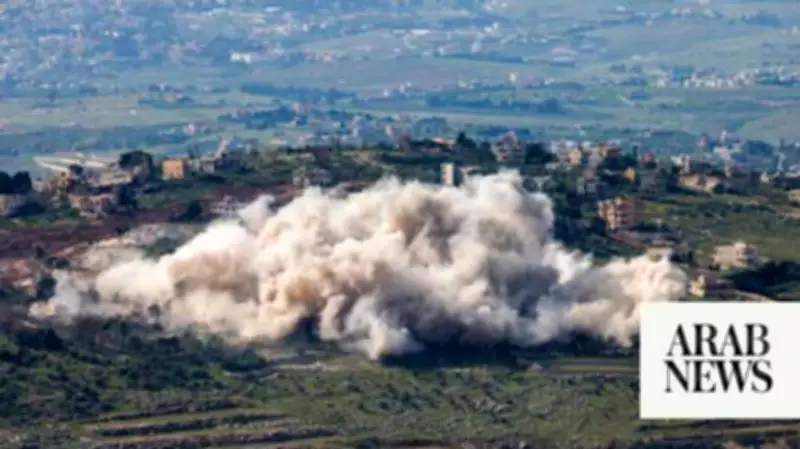
Hezbollah entered the wider regional war that began with US-Israeli attacks on Iran by launching rockets at Israel. Israel's retaliation has resulted in over 2,600 deaths, and its strikes on Lebanon have continued despite the truce.